














Collins Aerospace has begun initial tests of the integrated electric elements – including a pair of 1MW-class motors – that will be used to hybridise a Pratt & Whitney PW1100G engine as part of an EU Clean Aviation-backed project.
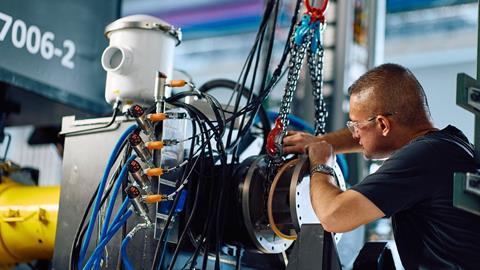
Taking place at the company’s electric power systems lab in Rockford, Illinois – also known as “The Grid” – the trials will validate the electric motor-generators, controllers and power distribution systems for the SWITCH engine.
These will later be installed onto the PW1100G for a later round of ground testing, as the MTU Aero Engines-led project wraps up later this year.
One of SWITCH’s goals is to demonstrate the feasibility of hybridising a narrowbody engine like the P&W geared turbofan (GTF), using electrical power to optimise engine efficiency across different phases of flight.
On a future GTF, the electric motors, incorporated on the high- and low-pressure spools, could assist the gas turbine by providing power for take-off and climb, allowing the thermal engine to be right-sized for cruise conditions.
Collins designed and produced the motors and controllers at its Solihull, UK facility, while power distribution components were designed in Nordlingen, Germany. GKN Aerospace built the high voltage electrical wiring interconnection system in Papendrecht, the Netherlands.
To meet its overall target of a 20% fuel-burn reduction, the SWITCH engine is also intended to incorporate a waste-heat recovery system to further increase engine efficiency.
By the end of the project in December this year, SWITCH should have taken the hybridised engine to technology readiness level (TRL) 5 through ground tests of the full propulsion system, while the waste heat recovery concept will be raised to TRL4 “through validation of its key enabling technologies”, Clean Aviation project documents state.
Clean Aviation has allocated €60 million ($70.3 million) in its fourth call for proposals – the latest during its second phase – to fund ground demonstrators of up to three hybrid-electric narrowbody engines. The selected projects will be revealed in the autumn ready to start in January 2027.
It is unclear whether flight testing will also be funded, although the Airbus-led COMPANION project, developed under Clean Aviation’s first phase is working to accommodate a hybridised engine aboard its A380 testbed.