













Rotorcraft manufacturer Sikorsky has delivered a new variant of the company’s venerable UH-60 Black Hawk utility helicopter to the US Army, one that can fly without pilots onboard.
Developed in partnership with the US Defense Advanced Research Projects Agency, the H-60Mx is the first Black Hawk model provided to the US Army that offers the option to fly completely autonomously or with reduced crew.
The army confirmed receipt of what it calls the “Optimally Piloted Vehicle” on 19 March, describing the new rotorcraft as “extensively modified to fly with or without a pilot at the controls.”
The service says it will now begin a test and evaluation campaign with the H-60Mx as part of a “push to build a safer, smarter and more versatile helicopter fleet for the future.”
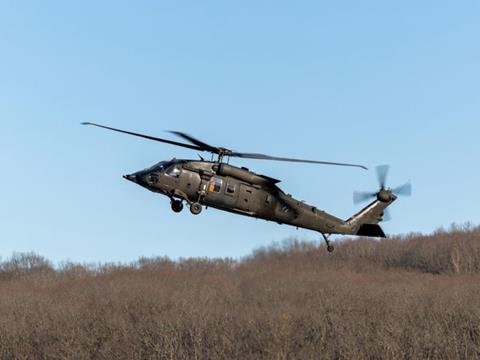
Sikorsky fabricated the H-60Mx using a standard, conventionally piloted UH-60M Black Hawk. Modifications to the aircraft included a new fly-by-wire flight control system and new flight computer to run the company’s proprietary Matrix autonomous flight software system.
Matrix also features a new suite of sensors installed around the Black Hawk to provide critical flight data to the algorithm that actually flies the aircraft.
Based on Sikorsky’s earlier UH-60A Optionally Piloted Vehicle demonstrator, the H-60Mx was funded via a $6 million grant from DARPA issued in 2024.
The secretive technology development agency also funded development of the Optionally Piloted Vehicle, which logged its first fully autonomous sortie with the in 2022, including two flights without any pilot onboard.
Previous tests had included a human aviators as a safety back-up.
Both the UH-60A and H-60Mx OPVs offer the option to switch between fully autonomous, reduced crew, and conventional flight operations with two pilots and one crew chief.
“This capability will enhance mission effectiveness and survivability for war fighters today and lay the groundwork for tomorrow’s networked systems,” says Sikorsky general manager Rich Benton.
The army note that the experimental Black Hawk’s new fly-by-wire flight controls improve stability and make the aircraft easier to handle, particularly in degraded visual environments and other similarly challenging conditions.
The OPV concept will allow for human pilots to get automated assistance at critical moments, while still retaining overall control of the aircraft.
“By automating difficult manoeuvres, the system dramatically reduces pilot workload, allowing the crew to focus less on the mechanics of flying and more on managing the critical mission at hand,” the army says.
This could also lead to the morphing of what tasks the army’s rotary-wing pilots are primarily focused on in the cockpit.
The ongoing development of new air-launched reconnaissance and strike drones the army calls “launched effects” could see aviators become so-called “mission managers” who oversee a wider array of battlefield functions.
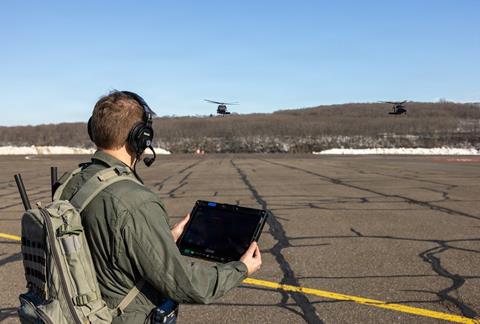
Another vision for the autonomous Black Hawk concept is offering frontline commanders the ability to send a completely uncrewed helicopter into conditions unacceptably dangerous for a traditional crewed rotorcraft.
Such scenarios could include casualty evacuation under fire or the resupply of critical materials like ammunition, batteries or water while ground troops are engaged in combat.
Sikorsky has previously demonstrated the ability to control the UH-60A OPV demonstrator with nothing more than a touchscreen tablet on the ground. Notably, non-aviators have been able to effectively direct and operate the rotorcraft in autonomous mode.
As the army moves forward with evaluating the newer H-60Mx, the service says test pilots and flight engineers will evaluate how the aircraft can be controlled from the ground, how it performs in complex mission scenarios and how the technology can be employed by frontline troops to improve safety and combat effectiveness.
A separate US Army programme with Near Earth Autonomy is exploring similar options for the service’s inventory of older UH-60L Black Hawks, using a demonstrator called the RUC-60.
The army has roughly 2,300 UH-60s in active service, including both the older “Lima” models and the newer “Mike” types, which are still in active production at Sikorsky’s Stratford, Connecticut plant.