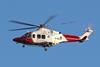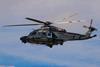
















Despite certification delays due to problems with a test stand, Sikorsky expects this year to achieve Federal Aviation Administration (FAA) approval for its upgraded S-92A+ heavy-twin helicopter and to secure more orders, including for aircraft already in production.
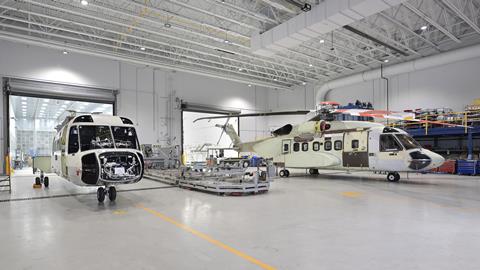
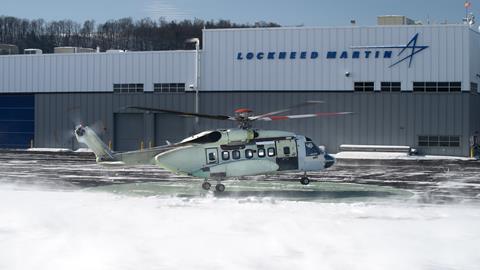
Meanwhile, the company is relocating final assembly of the S-92A+ to its facility in Owego, New York, having previously been building aircraft – only one or two annually – at its West Palm Beach site in Florida.
Sikorsky expects the Owego plant, which long has specialised in systems integration, will eventually have capacity to produce 12 S-92A+ aircraft annually.
While that annual output seems distant at present, Sikorsky executives are optimistic about the certification of the S-92A+’s new gearbox and the long-term commercial appeal of the GE Aerospace CT7-8A6-powered helicopter.
“The gearbox has been performing very, very well,” says Sikorsky director of global commercial and military systems Leon Silva. “We haven’t had any damage to the gearbox… and we’ve put it through some things that we weren’t planning to.”
“We have additional head-of-state customers that are interested in purchasing new aircraft, and I think some of those will come through this year,” he adds.
Sikorsky, part of Lockheed Martin, in 2019 revealed plans to upgrade its S-92A to the new A+ standard – a project that most notably has involved redesigning the main gearbox to include a secondary lubrication system.
The S-92A+’s new Phase IV gearbox – replacing the Phase III model – has a supplementary lubrication system consisting of piping around the gearbox’s exterior that provides oil to the gearbox should the main system fail. Although not a direct replacement for the main lubrication system, the secondary system contains sufficient oil to protect the gearbox until a landing can be made.
Sikorsky manufactured prior S-92 gearboxes from magnesium but makes Phase IV units from aluminium – a heavier material but one less susceptible to manufacturing defects and easier to bore and repair.
“It totally addresses any challenges with land-immediately requirements in the case of oil [system] failure,” says Silva.
The S-92A+ update also includes a gross weight expansion kit boosting the helicopter’s maximum take-off weight by 544kg (1,200lb) to 12,564kg, letting operators carry more passengers, cargo or fuel.
“The main gearbox is currently in its final phase of testing. It has gone through a lot of rigour,” says Sikorsky vice-president and general manager Rich Benton.
“We are down to the last endurance test. It’s about 200 hours of testing and then we have to complete the efforts with the FAA to finish that certification”, adds Silva.
But the project is behind schedule. This time last year, Sikorsky predicted having the gearbox certificated by end-2025.
That never happened, partly due to problems with the test stand Sikorsky uses in Stratford, Connecticut to put the Phase IV gearbox through its paces.
“We had some issues with the strength of [the test stand], so we had to beef that up,” Benton says, noting challenging test conditions created by extreme forces driven through the gearbox.
However, there were “no issues” with the gearbox itself, he adds. Sikorsky now expects the FAA will certificate the Phase IV gearbox this year.
“From a technical perspective, I am very comfortable that we’re going to pass [certification] as soon as we figure out how to fix our ground-based lab facility,” Silva says. “The team is making good progress towards doing that.”
Silva also attributes the years-long gearbox development and certification process to what he describes as a measured pace at which Sikorsky funded the $100 million project.
“That’s a pretty big number,” he says. “We had to spread that out over time in order to make it manageable.”
While awaiting certification, Sikorsky has started manufacturing five S-92A+s, of which two are spoken for, having been ordered as head-of-state transports. Sikorsky is producing the remaining three speculatively, in the belief that more orders will come shortly.
“We are very confident in this aircraft and that is why we are building some on-spec,” Benton says.
In addition to selling more S-92A+s in VIP and head-of-state layouts, Sikorsky foresees additional demand for the variant to fly utility and offshore energy missions.
“Offshore capacity requirements don’t appear to be growing significantly, but they’re growing modestly,” says Silva. “We will sell some new aircraft to offshore [operators] I’m convinced.”