














Canadian investigators have underlined the importance of tactile inspection after de-icing, following an incident involving a departing De Havilland Dash 8-100.
The Summit Air aircraft had taken off from Thunder Bay for a service to Moosonee in Ontario on 19 February.
While climbing through 10,000ft the pilots felt a vibration throughout the aircraft and the control column.
The crew declared an emergency and the turboprop returned to land at Thunder Bay.
According to a Transportation Safety Board bulletin the operator’s maintenance personnel inspected the Dash 8 and discovered a “layer of ice” on top of the elevator.
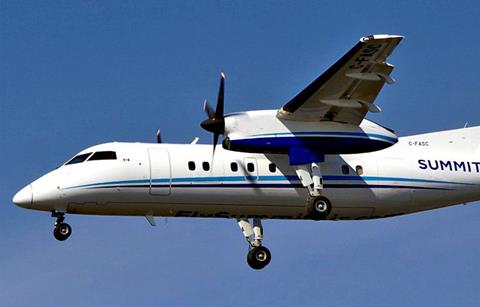
The Dash 8 has a T-tail configuration with the horizontal stabiliser and elevators about 7.5m above the ground.
Although the aircraft was de-iced by a third-party company – using Type I and Type III fluids – a probe by the service provider revealed that “only a visual post-de-icing inspection” was carried out, says the safety board.
“No tactile inspection was done,” it adds. The bulletin identifies the airframe involved as C-GONJ.
None of the three occupants was injured. The service provider has since implemented “several corrective actions”, says the safety board, including additional training and “stronger requirements for tactile inspections”.
Based in Yellowknife, Summit Air operates a diverse range of jet and turboprop aircraft including BAE Systems Avro RJs, ATR 72s, and other Dash 8 variants.