
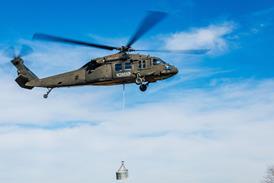















Airbus Helicopters has confirmed that it has stood up a European supply chain for the H175M, removing Chinese aerostructures from the military variant of its super-medium-twin.
At its outset, the baseline civil H175 was a joint venture between the European airframer and China’s AVIC, but during its unsuccessful pursuit of the UK’s New Medium Helicopter requirement, the airframer unveiled an H175M fuselage that had been made without Chinese content.
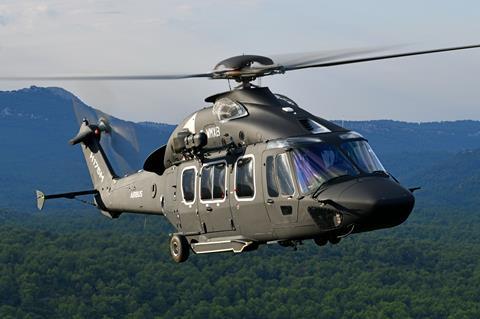
With orders for the H175M now beginning to materialise, including Spain’s commitment last year for six units, Airbus Helicopters has now activated its European supply chain.
“We have always been clear that the H175 in partnership with China was designed and qualified to address the civil market and that for the military market we would develop alternative sources to address this specific market,” chief executive Bruno Even told reporters during a 10 March press conference at the Verticon show in Atlanta.
“All these alternative sources were launched a few years ago and they are all now qualified.”
At the time, Airbus Helicopters indicated that suppliers included aerostructures providers from the wider group, including Airbus Atlantic. Other Chinese-sourced parts that have been replaced include the tail rotor transmission and intermediate gearbox.
While there are multiple opportunities in the market for the H175M, Airbus Helicopters is promoting the type in Canada for the country’s Next Tactical Aviation Capability Set (nTACS) requirement to replace its fleet of aged Bell CH-146 Griffons.
“Canada is clearly one of the customers we think the H175M would fit perfectly,” says Even. Under nTACS, Ottawa is seeking 80-plus helicopters for the Royal Canadian Air Force for delivery from 2028.
Should it be successful, those helicopters are likely to be built locally, says Bart Reijnen, president of the firm’s North American subsidiary Airbus Helicopters Inc.
“We see a huge ambition from the Canadian government to invest in new defence equipment and we see that the H175M is very well positioned for several of those ambitions, whether this is for the Canadian air force [or] the Canadian coastguard.
“So, we really see it as an aircraft for Canada, but if you were to go that way, it would also be an aircraft from Canada.”
Although Reijnen would not be drawn on details of its industrial plan for Canada, he points to the wider Airbus group’s presence in the country, including its Mirabel final assembly line for the A220 airliner.
“So, depending on where the Canadian government wants to go, as a group, we are very much willing to continue investing in that relationship, brining more work to Canada.”
While initially focused on the domestic customer, Reijnen says Airbus Helicopters could also potentially address the export market from any Canadian final assembly line.
“This will depend on how much work, how many helicopters the Canadian armed forces require,” he says, plus wider global demand.
Transport Canada recently certificated the H175, but a similar approval from the US Federal Aviation Administration continues to be elusive.
Reijnen says additional tests may be required by the US regulator this year, pushing the schedule into 2027. Initial European certification for the H175 was received in 2014.