














Sikorsky remains undecided what aircraft it will develop next but leaders insist future designs will make use of advanced manufacturing materials and processes that allow for faster development and streamlined production.
This slight uncertainty aside, the Connecticut-headquartered rotorcraft specialist is advancing several research programmes and expects this year to complete first flights of three demonstrators: a hybrid-electric tiltwing test vehicle, the Nomad 100 rotor-blown wing, and the U-Hawk – a fully autonomous UH-60L Black Hawk.
“We are in general exploring what our next product will look like,” says Sikorsky director of innovations Igor Cherepinsky. “It’s going to be fairly soon. The size class depends on us closing a couple of business cases we are working on right now.”
Though Sikorsky has, for several years, danced around product development questions, its technology development team has a full plate.
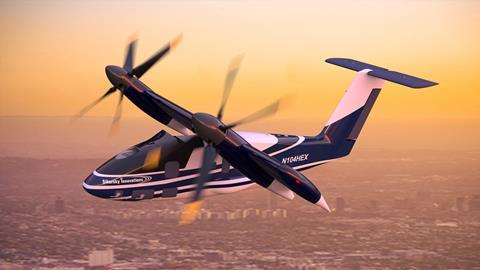
Front and centre is the company’s Hex programme, an effort to evaluate hybrid-electric vertical take-off and landing aircraft, with the prospect of bringing such a product to market.
Hex is still in its early stages, but progress continues, with Sikorsky aiming to get a “power systems testbed” (PSTB) airborne this year.
But do not expect anything flashy: Cherepinsky describes the PSTB as an initial stripped down demonstrator of a hybrid-electric tiltwing – a “wire-tube-frame” structure with a “simulated” tiltwing that, this being an early demonstrator, will not actually tilt but rather be immovable and in the vertical-flight position.
But with a propulsion system composed of two 600kW electric motors generating a combined 1.2MW, it will get off the ground, Cherepinsky says.
“That’s giving us a chance to go run the hybrid drivetrain. We are going to hover the aircraft [and] move it around the airfield at low speed,” he says. “The guts of the aircraft are exactly the same guts that are going in aircraft two and three.”
Those next aircraft will also be demonstrators. But they will be much more complete than the PSTB, having actual tilting wings. “The composite fuselages and the wings are being built right now. We are going to start assembly early next year,” Cherepinsky says.
Sikorsky anticipates flying those demonstrators in 2027 or 2028, using them to continue evaluating the hybrid-electric system and the tiltwing’s flight characteristics, including its transition from vertical to forward flight.
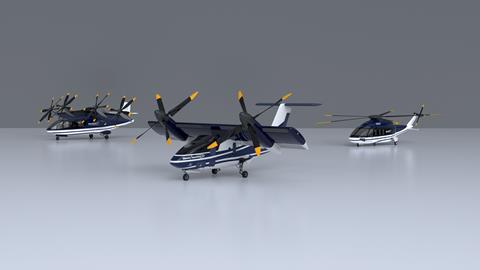
The Hex programme may not stop there. Sikorsky envisions rolling the technology into a larger passenger tiltwing for production, or perhaps a hybrid-electric helicopter with a single main rotor. Both have civilian and military applications.
Novel production processes are central to Hex, with Sikorsky having made some parts from thermoplastics and others, including “dynamic components” like gears, gearboxes and other “large metal parts”, using additive manufacturing (also known as 3D printing), Cherepinsky says. Such components have historically been cast or forged – processes much more labour-intensive.
“Our goal, really, is not just to come up with a hybrid-electric aircraft, but [to develop] a very different and new way of making air vehicles of all shapes and sizes,” Cherepinsky says.
“The next revolution is going to come from the ability to manufacture vehicles rapidly. Also to change them rapidly.”
Such would be a remarkable shift for an industry known to operate in timeframes measured in decades.
Aircraft manufacturers, after finalising basic designs, tend to stick with those designs for 30, 40, even 50 years, making tweaks along the way, Cherepinsky notes.
“We are looking at disrupting that. We want to move more to two- [or] three-year runs, and after that we do more-dramatic improvements. That requires a really different way of thinking about manufacturing and what the aircraft are made out of.”
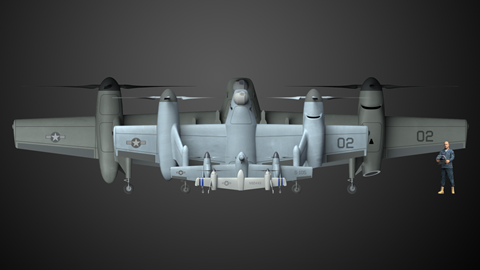
Also this year Sikorsky intends to complete the first flight of its autonomous hybrid-electric Nomad 100, a twin-propeller, tail-sitting rotor-blown wing derived from the smaller Nomad 50 prototype that flew for the first time last year.
The Nomad 100 has a 5.5m (18ft) wingspan and uses Sikorsky’s Matrix autonomy technology, which the firm has been developing for a decade.
“We are definitely flying it this year,” Sikorsky vice-president and general manager Rich Benton says of Nomad 100. “The system is going through ground runs and system-level checkout and subsystem-level checkout.”
He remains unsure about the flight-test programme’s pace, saying, “We’re going to go as fast as the technology can let us go. And [after] every successful test, we’re going to keep pushing the envelope from that, until we find an issue, and [then] we drop back.”
Sikorsky has already faced some Nomad setbacks, but the development team has adapted, including by tweaking parts and manufacturing them quickly using in-house additive manufacturing capabilities.
“They designed the part that day, and they built it the next day, and they’re back out testing within a couple of days,” Benton says. “It used to take us months or even a year when we had to wait for a supplier.”
The company envisions Nomads operating from land or ships and as commercial and military aircraft.
They will excel as cargo aircraft, with future variants capable of carrying 900kg (2,000lb) payloads. Other possible missions include light-attack, troop supply, search and rescue, maritime patrol, and intelligence, surveillance and reconnaissance (ISR). Sikorsky expects Nomads will operate alongside and in support of piloted helicopters.
“We are going to continue to scale that Nomad family up to larger and larger wings,” says Benton. “We believe some of the missions that we do today with our helicopters can be offloaded to the Nomad 100.”
“I expect this to be a very robust addition to the Sikorsky portfolio,” adds Sikorsky vice-president of strategy and business development Beth Parcella. “We do expect tremendous customer uptake in the near term.”
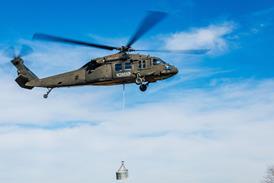
Additionally, 2026 is the year Sikorsky expects to get its S-70UAS U-Hawk, a fully autonomous modified UH-60L, off the ground for the first time.
U-Hawk is envisaged as suitable for military and civilian cargo operations, offering more cargo space than a piloted Black Hawk.
Revealed in 2025, U-Hawk evolved from Sikorsky’s “optionally piloted” OPV Black Hawk, which can be operated autonomously or by human pilots. Sikorsky has been flying the OPV autonomously since 2022.
U-Hawks have no crewed option. Indeed, Sikorsky removed the demonstrator’s cockpit, opening up more cargo space, and installed clamshell cargo doors.
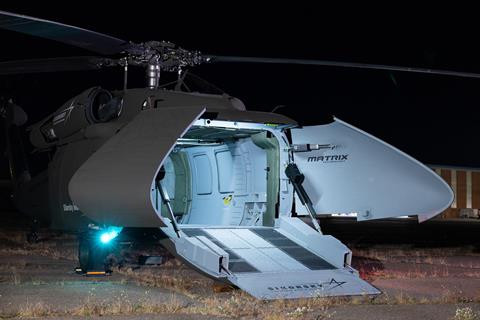
U-Hawk has 3,180kg of internal cargo payload capacity, 4,080kg of external-sling payload capacity and 4,540kg capacity split between the cabin and sling, Sikorsky says.
The company sees a broad opportunity to convert legacy UH-60Ls into U-Hawks. The US Army has some 600 of those helicopters and is planning retirements.
“We have received dozens of inquiries from potential customers about the U-Hawk and its capability,” says Parcella, adding that operators can “find a new life” for aging helicopters.
“Instead of retiring them, they can reconfigure them and modify them as a U-Hawk and provide that aircraft with increased life,” she says.