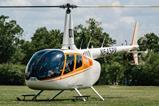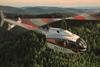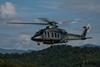














Robinson Helicopter has unveiled the TurbineTruck - an uncrewed cargo variant of its popular R66 turbine-powered light-single that will be equipped with Sikorsky’s Matrix flight-control system, delivering an autonomous platform capable of carrying loads up to 680kg (1,500lb).
And with uncrewed systems increasingly seen as a critical component of its future business, not least thanks to its 2024 acquisition of Ascent AeroSystems, a manufacturer of small drones, the California company has created a new business unit – Robinson Unmanned – to house all its interests in the segment.
Chief executive David Smith says the rotorcraft stalwart has been working with Sikorsky on the Turbine Truck development “for quite some time”.
Robinson engineers have already flown the Matrix system aboard a test aircraft – albeit not one of its own – and have “spent a good bit of time engaging with Sikorsky innovations team”, in preparation for aircraft integration activities.
Smith says the target is to fly the aircraft next year “but internally, we all think we can get it done faster”, dependent on “pacing that involves the customer”.
While not ready to identify the buyer, Smith confirms the programme “has a customer already established”.
He outlines two broad use cases for the TurbineTruck. On the civil side there are “special cargo” missions – time-critical deliveries to oil rigs, or urgent transfers of organs for transplant – and in the defence market “contested logistics” for multiple branches of the military, reducing the need for crewed resupply missions, whether in the air or on the ground.
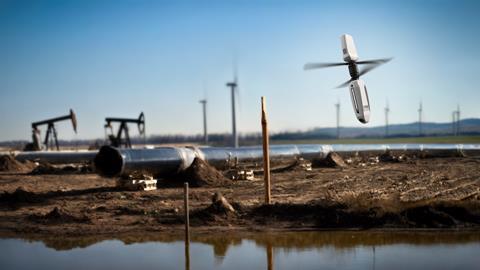
Added to which, Smith sees potential for the TurbineTruck to become “a sort of drone aircraft carrier”, transporting and deploying hundreds of small uncrewed air vehicles like those made by Ascent for surveillance or other roles.
“All these things are part of the thesis, but logistics is simple,” he says. The TurbineTruck, he says, “is elegant, it’s attritable and, you know, we can build it at great scale.”
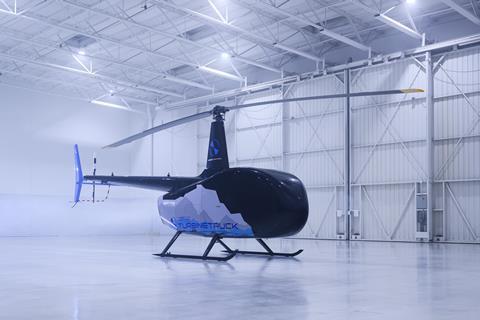
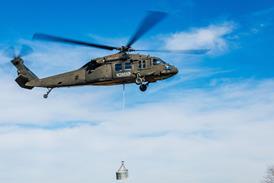
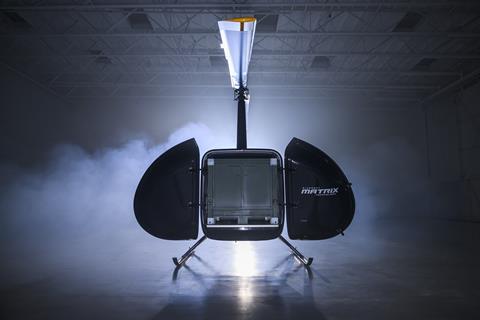
To facilitate logistics missions, Robinson removes the whole cockpit area, replacing it with front-opening clamshell doors, similar to those on the Sikorsky U-Hawk, simplifying the loading and unloading of palletised cargo.
Stripping out cockpit and manual flight controls also saves weight, boosting useful load to 1,500lb from 1,420lb on the standard R66. “And we are fairly confident that’s the beginning, not the end,” says Smith.
He sees further potential to reduce empty weight, not least because the crewed helicopter was designed to achieve the safety margins required for piloted civil operations.
“I think we can offer a lot more capability than the manned variant offers today. And I’m excited to evaluate trades with our customers, because everything is still a variable for us.”
Meanwhile, work continues with New Hampshire-based Rotor Technologies on the piston-engined R44-based Airtruck and Sprayhawk platforms for cargo and aerial spraying, respectively.
An initial customer aircraft is currently in development and should be shipped later this year, says Smith.
Smith calls the relationship between the two companies “a great collaboration” that has allowed Rotor Technologies to move beyond its initial plan of retrofitting its flight control system onto pre-owned R44s, a model dependent on the availability of feedstock for conversion.
Through the partnership, Rotor Technologies supplies its RPX autonomy suite – flight-control computers and actuators - for installation on the assembly line onto what is largely a standard Raven II.
“It’s a set of equipment that we install, check out, and then ultimately deliver. So, yeah, it’s a really nice set-up, I think, because everyone is in their place: we are the aircraft OEM, they are a major supplier of equipment.”
As with its R66-based bigger brother, the changes needed to turn it into an uncrewed helicopter removes weight, so much so, in fact, that “it actually brings the [centre of gravity] into a very different spot”, making the R44 aft-heavy, requiring recalculation on Robinson’s part.
The TurbineTruck, Airtruck and Sprayhawk now sit within Robinson Unmanned, a dedicated division headed by Paul Fermo, the current president of Ascent.
Smith says its creation was spurred by the realisation that “we’re moving into a new era of aviation” where manned and unmanned platforms will exist side by side, what he calls “the era of both”.
Robinson is uniquely positioned to build “attritable, dependable, aerospace-grade, low-cost, high-quality unmanned assets”, he contends.
“Our investment, in a sense, two years ago now, was the foundation that we wanted to lay for it. And now is the right time to formalize the Robinson Unmanned foundation for the future.”
But he insists it is not “trying to become a software company”, instead building a “truck” and then working “with the best in the industry on the autonomy kit”.