













Bell’s SPRINT-X developmental aircraft has received the designation X-76 following the completion of the type’s critical design review (CDR).
Completion of the CDR sets the stage for it to build a demonstrator, with the Defense Advanced Research Project Agency (DARPA) anticipating a first flight in early 2028.
The aircraft is being developed under the auspices of the Speed and Runway Independent Technologies (SPRINT) programme, a joint effort by DARPA and the US Special Operations Command.
The objective is to develop new runway independent technologies that can be scaled for military aircraft.
“For too long, the runway has been both an enabler and a tether, granting speed but creating a critical vulnerability,” says US Navy commander Ian Higgins, DARPA’s programme manager for SPRINT.
“With SPRINT, we’re not just building an X-plane; we’re building options. We’re working to deliver the option of surprise, the option of rapid reinforcement, and the option of life-saving speed, anywhere on the globe, without needing any runway.”
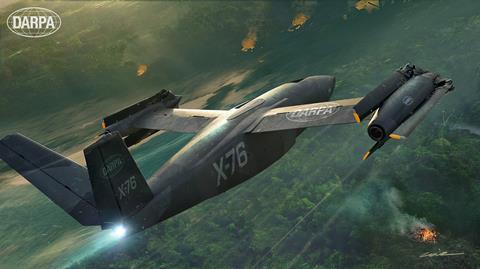
Bell’s solution for SPRINT rests on its “stop/fold” technology, where the aircraft takes off as a conventional tiltrotor. Once airborne, the propeller blades fold into the engine nacelles and the aircraft transitions to jet-powered flight.
In July 2025 Bell’s design was down selected for Phase 2 of the SPRINT programme, beating a rival design from Boeing unit Aurora Flight Sciences.
Phase 1A and 1B included preliminary design efforts. DARPA says that Phase 2 commenced in May 2025. Following the CDR, Bell will work on detailed design, building the vehicle, and ground testing. Flight tests will occur in Phase 3.
Specific SPRINT objectives include cruising at 400-500kts (741-926kmh) and the ability to operate from austere, unprepared surfaces.
“Bell is honoured to receive the X-76 designation and continue the spirit of American innovation honouring the founding of the United States in 1776,” says Bell executive vice president engineering Jason Hurst.
“This is an important milestone as the Bell and DARPA team advances to a historic first in aviation history and fulfil our mission of developing next-generation vertical-lift aircraft.”