













Boeing is slowing 737 Max deliveries to address a wiring issue that requires rework on produced-but-not-delivered jets, though it plans to keep 737 Max production humming at current levels.
The manufacturer disclosed the issue on 10 March, saying the problem does not jeopardise the safe operation of in-service 737 Max jets. Boeing also says the issue has not led it to revise its 2026 delivery goals.
The manufacturer discloses few details and does not say what wires are affected.
The US Federal Aviation Administration (FAA) did not immediately respond to a request for comment about the wiring issue Boeing disclosed on 10 March.
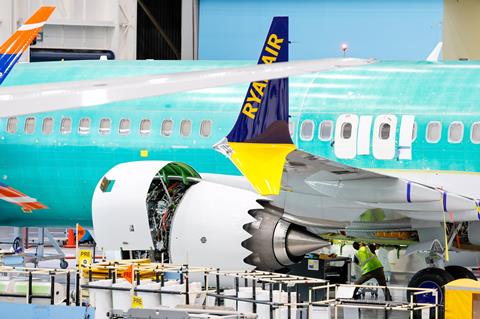
“Our 737 programme is performing rework on a group of airplanes to fix wires that have small scratches due to a machining error,” Boeing says. “This ensures they meet our quality standards before the airplanes are delivered.”
The wiring issue is the latest in a string of quality problems that for several years have affected in-production Boeing jets, especially 737s and 787s. Many of those issues have required costly and time-consuming rework, holding up Boeing’s deliveries.
Of late, however, Boeing seems to have put many of those problems behind it. In the last year the company significantly ramped 737 and 787 output.
Addressing the newly disclosed problem, Boeing says: “Production of new 737 Max airplanes continues at the existing rate… We expect some near-term delivery delays that may affect our deliveries in the first quarter. But given the rework timeline, we do not currently expect this issue to impact our year-end delivery total.”
An engineering analysis determined that “the small scratches do not present an immediate safety of flight issue”, Boeing adds. “All in-service 737 Max airplanes can continue to safely operate. If action is required for the in-service fleet, we will issue updates through our normal service bulletin process.”
The aircraft manufacturer has informed the FAA and customers about the latest issue, it adds.
Boeing has been producing 737s at a rate of about 42 monthly. It has planned to accelerate to 47 monthly before year-end and to deliver 500 737s this year.
The news comes after the FAA on 24 February issued an urgent order to address a potential 737 Max “ground wire fault” that can cause environmental control systems to make the jets’ cabins dangerously hot.
That order requires airlines to update flight manuals to include new pilot procedures. It is unclear if the latest issue is related.
FEBRUARY ORDERS, DELIVERIES
Despite the wiring issue, Boeing kept deliveries humming in February, handing over 51 aircraft during the month, up from 46 in January. The February deliveries included 43 737 Max, three 767s (two freighters and one 767-based KC-46 military tankers), two 777 Freighters and three 787s.
Boeing’s order activity slowed to just six net new orders (accounting for cancellations and accounting adjustments) in February.
WestJet cancelled orders for six 737 Max last month. It did not respond to a request for comment.
Also in February, Boeing moved orders for nine 737 Max from its backlog to an accounting bucket reserved for deals the company suspects will not actually close.
Meanwhile, WestJet last month placed new orders for two 787s, an unidentified customer or customers ordered seven 737 Max and one 787, Kazakhstan’s Air Astana ordered five 787s and unnamed customers ordered six KC-46s, Boeing says.
The US manufacturer ended February with 6,151 aircraft in its backlog, down from 6,196 at the end of January. Its backlog includes 4,388 737s, 96 767s, 609 777s and 1,058 787s.