










Two of Europe’s leading lights in electric aviation have provided more detail about a collaboration that could see the Aura Aero Integral E used as a testbed for elements of partner Vaeridion’s propulsion system, or involve the pair sharing production capacity.
Signed at the Paris air show last month, the “strategic partnership” between the firms – both founded by ex-Airbus employees – is intended to “advance electric flight”.

It foresees several areas of co-operation, including adopting common charging standards, exploring other technical commonalities and jointly advocating policy frameworks. The pair also intend to share test assets, expertise and production facilities where appropriate.
Ivor van Dartel, founder and chief executive of Munich-based Vaeridion, says the collaboration is born of “mutual respect”.
“Obviously, the two companies are [distinct], and we have our own programmes,” he adds. “But we clearly understand that we are not in competition – we have different aircraft that we develop for different markets – so we have a lot to gain from co-operating.”
Vaeridion is working on a nine-passenger all-electric aircraft it calls the Microliner. Powered by an innovative transmission that combines output from two Evolito electric motors to drive a single propeller, the predicted-215nm (400km)-range aircraft could enter service by the end of the decade.
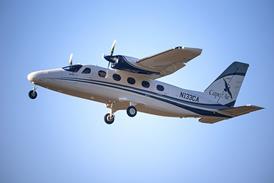
Toulouse firm Aura Aero, meanwhile, is developing two models: the Integral E, a battery-powered version of its two-seat trainer, and the ERA, a hybrid-electric 19-seater for regional routes of up to 900nm.
Already in flight testing, the Integral E is scheduled to enter service in 2026. Once that happens, Aura’s five flight-test vehicles will be free for other roles, says chief executive Jeremy Caussade. “We could think easily to test the batteries, an electric engine or whatever, using one of our platforms.”
“What we are now investigating, once we have done our initial ground qualifications on our copper bird, is whether we could fit one of those aircraft with… the same [powertrain] bricks from which we build up our entire system, and then do initial flight tests on their platform,” adds van Dartel.
While the Integral E’s existing Safran ENGINeUS 100 electric motor would be retained, “there will be a de-risking that could happen in the year 2026 on the road to the first flight of our full-size aircraft.”
Vaeridion’s expertise is largely with batteries, taking commercially available cells and building them up into around 60 battery packs installed along the wing ribs.
The Micoliner’s propulsion system is sized to deliver 800kW of peak output, far more than required by the around 140kW Integral E. As a result, fewer than 10 battery packs would be needed to power the smaller aircraft, says van Dartel.
Initial analysis suggests “we can reuse the existing pack design and plug it into their current set-up”, he says, “without too much redesign at our end”.

Vaeridion may also investigate applying its transmission system to the ERA, to increase power per propeller.
Shared production capacity may be an area of collaboration, says Caussade, who points out that Aura has “invested massively” in a “very big industrial facility” at Toulouse Francazal airport.
An identical factory will also be constructed in the USA, where “having a joint facility would make absolute sense”, says van Dartel.
Although Vaeridion’s main European final assembly line will be located near Munich, “depending on how many aircraft will be sold to which customers in which countries, that part of the industrial scope could be done in other facilities”, he adds.
Aura is also investing in composite manufacturing, van Dartel notes. “So, for those work packages where we have made no decision, we are very happy to work together with friends”.
Meanwhile, the German company continues advancing the Microliner’s development: detailed design work is now under way which should conclude with a preliminary design review later this year.
As the batteries will be located inside the wing box, the slender, 24m (78ft)-span composite wing with a high glide ratio is central to the aircraft’s success.
Vaeridion has already built a 1m-long wing demonstrator with a “representative wing profile”, with a second demonstrator – a 3m section – “being built as we speak” in partnership with the Technical University of Munich.
“The main purpose is to demonstrate we can build a wing of those dimensions and also access the batteries; the access panel approach we’ve come up is pretty fancy for this one.”
To follow will be a full 12m structure that will undergo aeroelasticity tests, he adds.
Vaeridion is already working with GKN Aerospace on the high-voltage electrical distribution system for the Microliner and may engage GKN to build a fourth wing demonstrator to evaluate manufacturability, says van Dartel.
GKN may also be recruited to produce the empennage, he adds: “They have some very interesting technologies in their portfolio, for example, on the thermoplastic side to produce even lighter aerostructures.”
First flight of its initial production-conforming aircraft will be at the end of 2027 or in early 2028, the company says.