












The US National Transportation Safety Board (NTSB) has released a cockpit simulation of the fatal 2025 collision between a passenger jet and a US military helicopter near Ronald Reagan Washington National airport.
That incident on the night of 29 January 2025 killed 67 people, including all 64 aboard an MHIRJ CRJ700 operated by PSA Airlines, a subsidiary of American Airlines, that was on final approach to land.
The remaining three victims were crew aboard a US Army Sikorsky UH-60L Black Hawk operating in a formerly active helicopter route along the Potomac River.
During a 27 January public hearing, NTSB officials released details of their investigation into the deadly crash, including a digital recreation showing the cockpit view from both the CRJ700 and the UH-60L moments prior to the collision.
The video, overlayed with recorded audio from air traffic controllers and the CRJ700 crew, depicts the final 2min of the doomed flight, as the regional jet follows the Potomac River on final approach to runway 33.
In the video, the running lights of the Black Hawk, call sign PAT 25, are barely visible through the CRJ700’s cockpit windscreen – hidden among lights of the American capital city below.
Even with PAT 25 circled and identified in the NTSB animation, the helicopter is nearly impossible to discern.
It is not until the PSA Airlines jet passes directly over the dark Potomac River that the outline of the Black Hawk becomes visible.
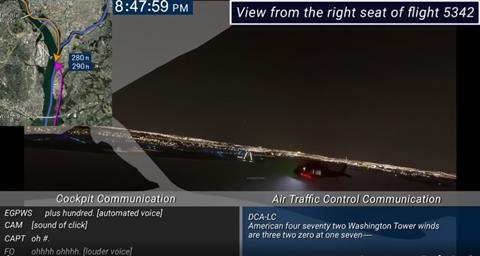
At that moment, the CRJ700’s captain and first officer make verbal exclamations indicating they recognised the danger.
The animation shows that the jet pulled up and left, likely to avoid the UH-60L, which was travelling south along the river, moving right-to-left from the perspective of the CRJ700 cockpit. That manoeuvre was unsuccessful to avoid the collision, which sent both aircraft crashing into the icy winter waters of the Potomac.
The Black Hawk was later determined to have been flying at roughly 300ft altitude – exceeding the 200ft altitude cap for rotorcraft operating in that section of Washington Route 4, which passes under the approach to Washington National’s runway 33.
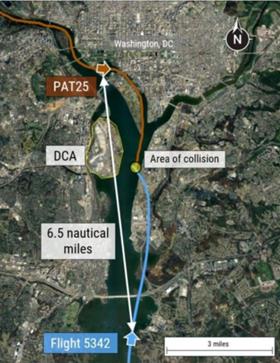
In a December court filing, the US government admitted fault for the incident, assigning blame to the US Army and Federal Aviation Administration (FAA), which oversees air traffic control and established rules for rotary-wing aircraft operating along the Potomac.
The UH-60L crew was conducting a night proficiency flight when the collision occurred, part of normal annual assessments for army aviators. Such evaluations require using helmet-mounted night-vision goggles, which limit operators’ fields of view and amplify ambient light.
While that feature is useful when flying over dark terrain or at higher altitudes, using night vision over highly illuminated cityscapes may have contributed to a lack of situational awareness.
A separate NTSB rendering reveals the degree to which the UH-60L pilots’ views might have been reduced by night vision.
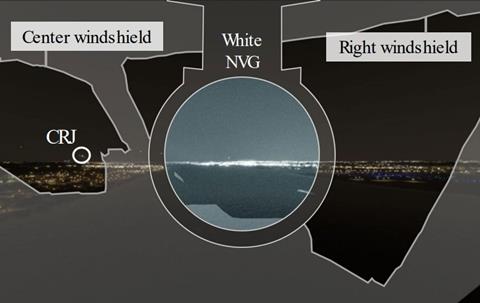
The image – depicting the view from the Black Hawk’s right cockpit seat 19s before the collision – shows the CRJ700 as faintly visible out the centre windscreen, but obstructed if the operator were using night-vision and looking straight ahead.
The NTSB notes the rendering does not account for additional light such as stars, which night-vision goggles are designed to amplify for visual navigation.
Results of the investigation found no evidence that crew fatigue, medical complications or physical impairments contributed to the accident.
“Both aircraft were properly certificated, equipped and maintained,” the agency says.
Investigators also found no evidence that atmospheric anomalies impacted the UL-60L’s barometric altimeter – a theory that emerged immediately following the incident.
The FAA has permanently closed that section of airspace to non-emergency rotorcraft traffic, following up on a temporary ban issued in 2025. That move aligns with an NTSB recommendation issued in March 2025.