












The US government has admitted fault in the deadly crash involving a US Army helicopter and a PSA Airlines regional jet in Washington, DC earlier this year.
The admission was made in a 17 December filing with the federal district court for Washington, DC which is considering a wrongful death lawsuit brought against the US government, American Airlines and PSA Airlines by the widow of one of the crash victims.
“The United States admits that it owed a duty of care to [the] plaintiffs, which it breached, thereby proximately causing the tragic accident on January 29, 2025,” the court filing states.
The government further acknowledges the right of the plaintiff to recover monetary damages for the incident.
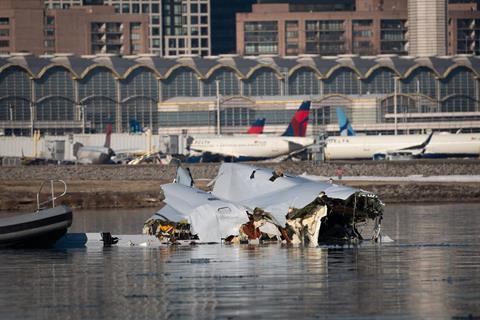
Sixty-seven people were killed in the incident, during which a Sikorsky UH-60L Black Hawk operated by the US Army collided with a PSA Airlines Bombardier CRJ700 on approach to Ronald Reagan Washington National airport.
The regional jet was en route from Wichita, Kansas operating as an American Airlines flight.
Notably, the US government filing also admits liability on the part of American and its subsidiary PSA Airlines.
“The defendants’ collective failures (for which they are jointly and severally liable) caused, and/or contributed to this senseless and entirely avoidable tragedy,” the statement declares.
From the government side, the filing specifies that fault lies with both the US Army and Federal Aviation Administration (FAA), which operates the nation’s air traffic control system and established rules for rotary-wing aircraft operating along the Potomac River – where the crash occurred.
A subsequent investigation found that the army crew was in breach of strict altitude limits set by the FAA for the helicopter route that follows the Potomac River south of Washington. That corridor, which skirts Regan National airport and crosses multiple approach vectors for commercial aircraft, has since been shuttered by the FAA.
Exacerbating the violation of altitude ceiling rules, the army helicopter was also operating without an active transponder, a practice allowed under government rules for military flights. That practise has since come under fire, but has not been officially banned.
The US government’s admission of fault notes there have been “a substantial number of ‘near miss’ events in and around DCA”.
“Because of defendants’ collective failure to analyse the data and information at their disposal, and due to their failure to operate and/or control aircraft with the highest degree of safety, this mid-air collision was, tragically, an accident waiting to happen,” the government notes.
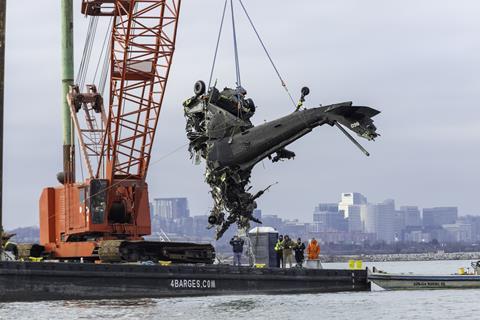
However, the filing also suggests that the PSA Airlines flight crew also bore some responsibility for the incident, saying that pilots onboard both of the incident aircraft “failed to maintain vigilance so as to see and avoid each other.”
“The airline defendants failed to implement policies and procedures specifically designed to mitigate the risks associated with a mid-air collision,” the admission states.
Other failings are detailed, including to adequately train flight crews on the hazards associated with the helicopter routes around Regan National airport.
Also at issue is the decision by air traffic controllers to issue a last minute directive to the inbound regional jet to land on the shorter Runway 33, rather than Regan National’s primary landing strip.
That decision proved fatal, as Runway 33’s orientation required the CRJ700 to make its final approach from across the Potomac, where the fatal impact ultimately occurred.
The army Black Hawk was improperly operating over the centre of the river, rather than along the eastern bank as regulations stipulated. Flight tracking from the time of the incident shows the UH-60L veered toward the Potomac’s centreline just moments before the collision.
Government lawyers also lay severe blame at the feet of air traffic controllers, who they say “failed in their two most important priorities, namely to separate aircraft in airspace and issue safety alerts when aircraft are in an unsafe proximity to one another”.
The Potomac River crash was the USA’s worst commercial aviation accident in more than two decades.