














Following the USA’s dramatic capture of deposed Venezuelan leader Nicolas Maduro, footage emerged apparently showing one of the Pentagon’s most-secretive aircraft supporting the mission.
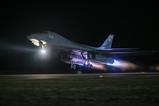
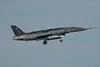
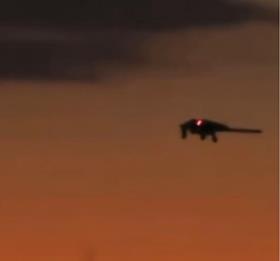
Video circulating on social media shows what appears to be a Lockheed Martin RQ-170 Sentinel uncrewed aerial vehicle (UAV) on final approach to an undisclosed airfield.
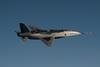
The flying-wing jet is silhouetted against the orange sky, with its wingtip anti-collision lights illuminated and tricycle landing gear extended. A separate video apparently shows an RQ-170 flying directly over the photographer as the aircraft pulls into a climb.
In both cases, a blinking white strobe – significantly brighter than the anti-collision lights – is seen on the rear fuselage.
While the location of the footage is unconfirmed, the airfield could be Roosevelt Roads Naval Air Station on the US island of Puerto Rico. Washington has surged assets to the previously shuttered base, including Lockheed Martin F-35 stealth fighters, as part of its Caribbean build-up.
Audio accompanying the RQ-170 footage further supports the Puerto Rico assessment.
The distinctive chirping sound of coqui frogs can be heard over the growl of a jet engine. Those small tree frogs are endemic to the tropical forests of Puerto Rico – easily distinguishable from the desert landscape of Creech AFB in Nevada, which the US Air Force confirmed as home to the RQ-170 in 2009.
Citing anonymous government sources, The New York Times reported on 3 January that a “fleet of stealth drones flying secretly above” Venezuela helped the US Central Intelligence Agency collect detailed information about Maduro’s routines and monitor his travel patterns in the months leading up to the operation.
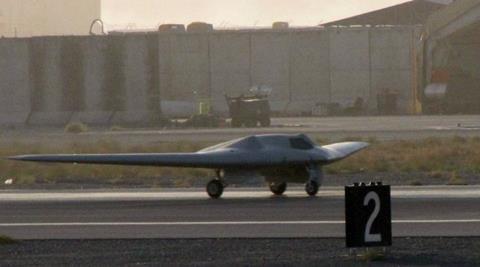
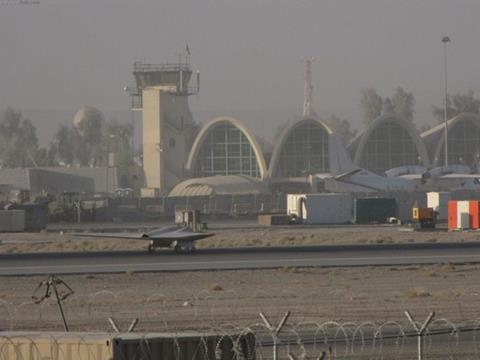
Little is known about the highly secretive Sentinel drones, which provide intelligence, surveillance and reconnaissance support to combat forces. The USAF revealed the RQ-170’s existence in 2009 after unofficial images of the jet operating from a US air base in Afghanistan began circulating online.
The Sentinel platform was again thrust into public view in 2011, when one of the jets crash-landed in Iran.
That RQ-170 was captured by Tehran, which is now believed to have employed an early version of GPS spoofing to bring down the aircraft inside Iranian territory with minimal damage. Iran subsequently claimed that it reverse-engineered the captured Sentinel to support the country’s own indigenous UAV development efforts.
A 2009 USAF fact sheet, since taken down, described the RQ-170 as a low-observable platform uniquely suited for supporting missions like the Maduro raid, which required precise real-time information on the whereabouts of the target and defences along the flight corridor.
“The RQ-170 will directly support combatant commander needs for intelligence, surveillance and reconnaissance to locate targets,” the air force said at the time.
More than 150 military aircraft were involved in the raid on Caracas, officially dubbed Operation Absolute Resolve. That armada included bombers and strike fighters sent in ahead of the raid force to neutralise Venezuelan air defences.
Boeing MH-47Gs – the special operations variant of the Chinook – ferried an assault force of US Army commandos and law enforcement officers to the compound where Maduro was located.
The deposed head of state was then flown via helicopter to the USS Iwo Jima amphibious assault ship, which has been stationed off the coast of Venezuela since mid-2025.
Footage of the MH-47G assault force flying low over Caracas emerged on social media almost immediately after the operation began, even before Washington had claimed responsibility for the action.