
















In a major milestone in the effort to field autonomous tactical aircraft, the US Air Force (USAF) has begun the process of integrating weapons onto its Collaborative Combat Aircraft (CCA) prototypes.
Speaking at the 2026 Air & Space Forces Association Warfare Symposium in Denver, Colorado on 23 February, the air force’s top general revealed that one the service’s two YFQ-series jets is now flying with inert missiles.
During his remarks, air force chief of staff General Kenneth Wilsbach shared a photo of the Anduril Industries YFQ-44A conducting a captive carry test flight with an externally carried missile assembly.
“We are following the same detailed approach used in every other aircraft developmental test programme to validate structural performance, flight characteristics and safe separation,” says Wilsbach.
“This ensures the CCA can safely integrate inert weapons before future employment,” he adds.
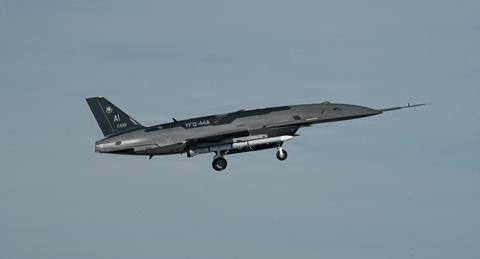
In the image shared by the USAF, the weapon appears to be a Raytheon AIM-120 Advanced Medium Range Air-to-Air Missile. Multiple blue-painted bands are visible on the missile body, signifying an inert body meant to be used for training.
Conventional high-explosive munitions are marked with yellow markings under the standard US/NATO ammunition labelling scheme.
Both the YFQ-44A and rival General Atomics Aeronautical Systems YFQ-42A began flight testing in the second half of 2025.
The two companies have taken slightly different approaches in the sequencing of their test campaigns on matters such as fully automated take-off and landing, leading the two aircraft to hit major milestones at different points.
The YFQ-44A notably carries air-to-air weapons externally, while General Atomics opted for internal bays on the YFQ-42A, meaning the munitions integration process may look quite different for the two prototypes.
The air force says the current phase of testing with inert missiles will ensure the YFQ-44A can safely carry external stores.
Both aircraft are designed for an air-to-air combat role, which the USAF says will be its operational priority for the first generation of frontline CCAs.
Additional mission sets are expected to be added on subsequent aircraft increments, including air-to-ground strike and electronic warfare.
“We are moving with urgency and purpose to deliver game-changing capabilities to our war fighters,” Wilsbach says.
The USAF has previously said it hopes to select the winner of its first CCA competition by late 2026.