










In the latest instance of rapidly evolving drone tactics being used in the Russia-Ukraine War, Moscow’s forces appear to have outfitted a disposable one-way attack drone with anti-air capability.
Photos circulating on social media show a Shahed-136-type uncrewed aerial vehicle (UAV) modified to carry a man-portable air defence missile system – commonly known as a MANPADS.
The normally shoulder-fired missile is mounted on the forward dorsal section of the delta-wing UAV, located just behind the nose section that typically carries an explosive warhead for striking ground targets.
Russia now produces a domestic version of the Iran’s propeller-driven Shahed-136, locally designated the Geran-2.
Ukrainian Major General Vladyslav Klochkov confirmed the authenticity of the photos, saying the one-way UAV had been fitted with a camera and radio modem to remotely fire the missile.
“The missile launch is carried out by an operator from Russian territory. The enemy is seeking new ways to destroy our aircraft,” Klochkov said in a post to social media.
Klochkov is a former ground forces commander who now heads the Directorate of Psychological and Moral Support for the Ukrainian armed forces.
MANPADS systems contain guidance systems, often infrared-based, meaning the drones do not necessarily need to be outfitted with additional sensors or onboard power.
Ukraine has adopted the tactic of shooting down Shahed/Geran kamikaze drones with air-to-air guided munitions launched by manned fixed-wing fighters, including the small fleet of Dassault Aviation Mirage 2000 fighters donated by France and UAC MiG-29s left over from the Soviet Union period.
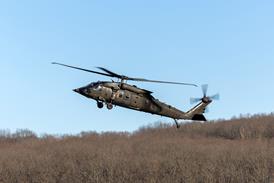
Rotary-wing aircraft have also been deployed in this capacity, engaging the slow-moving attack drones with door-mounted machine guns. Such helicopters would be particularly vulnerable to guided missiles, with slower airspeeds, lower operating altitudes and fewer onboard countermeasures than fixed-wing fighters.
The USA adopted similar tactics during its Red Sea campaign against Yemen’s Houthis, outfitting Lockheed Martin F-16 and Boeing F-15E fighters with BAE Systems’ low-cost APKWS II laser guided rockets for drone defence.
Use of manned aircraft to intercept attack drones allows Kyiv to husband its scarce and expensive ground-based air defence missiles, which can be used to engage more capable cruise and ballistic missiles fired by Russia into Ukrainian cities.
The addition of an anti-air munition would seem to be a Russian tactic aimed at countering this defensive approach by threatening Ukraine’s fighter interceptors – which would not be expecting an air-to-air threat from such a platform.
“Army aviation pilots must consider this new threat and avoid approaching the Shahed on its return course,” Klochkov confirms.
Ukraine is currently seeking to significantly expand its fleets of both fixed-wing fighters and combat helicopters.
Kyiv has signed letters of intent with Swedish manufacturer Saab covering up to 150 Gripen E/F fighters and with French airframer Dassault for as many as 100 Rafale F4 tactical jets.
For rotary-wing aviation, the Ukrainian government has signed an industrial cooperation agreement with American rotorcraft specialist Bell covering the possible acquisition of AH-1Z attack and UH-1Y utility helicopters.
Bell executive Jeffrey Schloesser told FlightGlobal in November that both the company’s H-1-model aircraft feature sophisticated onboard countermeasures that can help them survive against modern threats like MANPADS.