










US propulsion start-up Beehive Industries has cleared a major milestone in the test campaign for its new Frenzy engine and is now preparing to begin flight trials.
The Colorado-based manufacturer on 8 December said it has concluded high-altitude stand testing on the developmental Frenzy turbojet and now plans to launch flight testing in the first quarter of 2026.
“The milestone confirms Frenzy’s readiness for flight integration,” says David Kimball, Beehive’s chief technology officer. “Frenzy is now flight-ready, and our production system is ready to scale alongside it.”
Beehive is developing the 200lb-thrust (0.89kN) Frenzy under a 2024 research contract with the US Air Force. The company envisions Frenzy as a family of small turbojets ranging in size from 127-203mm (5-8in) in diameter and delivering 100-300lb of thrust.
Two prototype engines were provided to the air force in October, shortly after Beehive completed ground testing on the Frenzy.
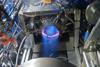
Altitude chamber tests were carried out at a government facility in Ohio, during which Beehive says the turbojet demonstrated performance capability across the engine’s full flight envelope.
Evaluated functions included ignition and operation, rapid acceleration from ignition to full thrust and assessing hardware durability and performance.
Beehive says the altitude testing showed better-than-expected results for both fuel consumption under specific thrust outputs and heat build-up around turbine blades.
The company says the engine components were also found to be in “like new” condition after a equivalent run time of a full mission life.
Ahead of flight trials, Frenzy will be integrated into a flight test vehicle that will act as a surrogate for the type of long-range cruise missiles and uncrewed aircraft Beehive is hoping its new turbojet will eventually power.
If the test campaign goes well, the company says it is prepared to launch low-rate production on the Frenzy at facilities in Denver, Cincinnati and Knoxville.
Beehive is amongst the collection of both established and start-up propulsion manufacturers seeking to capitalise on surging global interest in low-cost munitions and uncrewed aircraft.
Industry heavyweights including Pratt & Whitney, GE Aerospace, Rolls-Royce and Honeywell Aerospace are all pursuing new jet engines that fall in the 800-1,600lb-thrust range, targeting the emerging category of autonomous fighter jets currently being tested in the USA, Australia and Turkey.
Williams International’s FJ44 business jet engine has emerged as an early leader the, being one of the few commercially available options in the appropriate range of size and power. That turbofan offers 3,600lb-thrust at a weight of 303kg (670lb), while Wiliams’ smaller FJ33 sits firmly in window for small uncrewed fighters at 1,850lb-thrust and 145kg.
In addition to the established players, number of start-ups have also jumped into the race for new propulsion solutions, including Beehive, JetCat Defense and Ursa Major.