













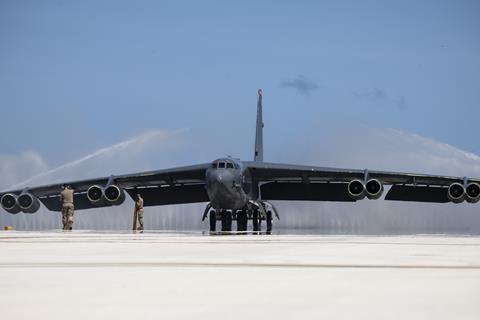
US airframer Boeing has been awarded a contract worth more than $2 billion to modernise the company’s iconic B-52H heavy-bomber with new turbofan engines.
The US Air Force (USAF) approved the funding on 23 December as part of the B-52 Commercial Engine Replacement Program (CERP), which has been underway since 2018. The latest contract marks a significant milestone for the re-engining effort, funding the integration of new powerplants on two B-52H aircraft.
Each bomber is currently powered by eight Pratt & Whitney (P&W) TF33 turbofans, mounted in the B-52’s unique dual-pod, underwing configuration.
The funding approval comes after CERP propulsion supplier Rolls-Royce cleared a USAF critical design review (CDR) in December 2024. That technical assessment is a key point in the US military procurement process and is meant to ensure a new system is ready to advance into fabrication, demonstration and testing.
Among the attributes reviewed in the CDR are ability to meet performance requirements within cost and schedule targets.
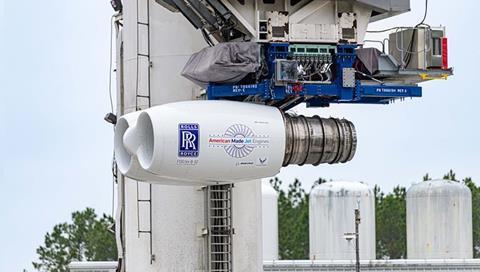
Rolls-Royce beat out rival engine makers P&W and GE Aerospace for the CERP contract in 2021 with a derivative of the company’s BR725 commercial powerplant designated the F130.
The company began stand testing the F130 in 2023 using the B-52’s dual-pod arrangement.
Work on the B-52 re-engining is expected to be complete by 2033, with the Pentagon noting that the $2 billion in test and integration funds will be distributed out to Boeing piecemeal over the ensuing period.
Just under $36 million has been made available immediately.
Rolls-Royce is expected to assemble more than 600 of the F130 powerplants for the CERP effort at the company’s site in Indianapolis, Indiana.
The re-engining programme is part of a broader B-52 service life extension that will see the current H-model bombers redesignated the B-52J.
In addition to new propulsion, each of the USAF’s 76 B-52 bombers will receive Raytheon’s AN/APQ-188 active electronically scanned array (AESA) radar, updated communications for both conventional and nuclear missions, new crew compartments and improved avionics.
New weapon systems are also being integrated into the Cold War-era strategic bomber, with a particular focus on long-range air-to-ground strike missiles.
Boeing delivered a B-52H equipped with the new AESA radar to the air force earlier this month for ground and aerial testing, scheduled for 2026. A production decision for a fleet-wide radar upgrade is expected later that same year.
Current projections have the USAF reaching initial operating capability for the B-52J in 2033 – including both the new radar and F130 engines.
That remains in-line with estimates from recent years, but still three years beyond the original target for the B-52J fleet upgrade programme.
The modernisations are central to Washington’s plans to keep the B-52 fleet in operation for at least another three decades.
While the newer Boeing B-1B and Northrop Grumman B-2 bombers will be retired as the next-generation Northrop B-21 Raider enters service, the B-52J will remain on frontline status for the foreseeable future.
The USAF’s fleet of 76 B-52Hs has an average of 64 years old, according to data from aviation analytics company Cirium.
Although each bomber is already more than twice the age of most B-52 crew members, air force leaders now openly discuss the prospect of the fleet reaching 100 years of active service.


![[Photo4] AESA radar mounted on a platform simulator for ground-based functional and performance testing before flight trials](https://d3lcr32v2pp4l1.cloudfront.net/Pictures/100x67/3/4/5/115345_photo4aesaradarmountedonaplatformsimulatorforgroundbasedfunctionalandperformancetestingbeforeflighttrials_783684.jpg)