












Rolls-Royce has completed altitude and operability tests for the F130 engine that will power the US Air Force’s (USAF’s) future fleet of upgraded Boeing B-52J bombers.
The work was conducted at the USAF’s Arnold Engineering Development Complex (AEDC) in Tullahoma, Tennessee, says Rolls-Royce.
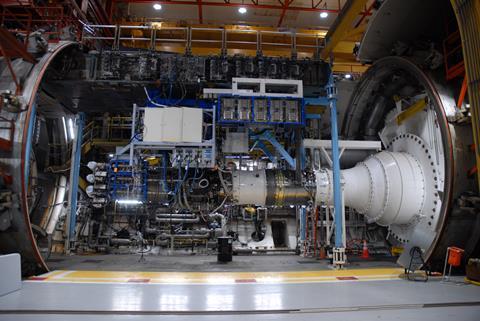
Working with the USAF, Rolls-Royce validated its F130 engine in mission conditions.
The company tested how the engine will perform in long-duration, high-altitude missions, including with “turbulent, real-world airflow”.
Also tested was the new Integrated Drive Generator, which will provide electrical power during missions.
“Throughout this F130 engine test campaign, we gathered essential data about how this engine operates across the full spectrum of flight conditions,” says USAF Lieutenant Colonel Timothy Cleaver, who leads the engine replacement effort for the B-52.
“Completing the series of tests at AEDC’s world-class facility gives us confidence in the engine and associated systems as we proceed into test aircraft modification and flight testing.”
The F130 completed its critical design review in late 2024, setting the stage for the first flight test engines.
Ultimately eight F130s, derived from the company’s BR725 commercial engine, will power the B-52J. They will replace legacy Pratt & Whitney TF33 engines under the B-52 Commercial Engine Replacement Program.
In addition to new propulsion, each of the USAF’s 76 B-52 bombers will receive Raytheon’s AN/APQ-188 active electronically scanned array radar, updated communications for both conventional and nuclear missions, new crew compartments and improved avionics.
The USAF is expected to reach initial operating capability for the B-52J in 2033 – including both the new radar and F130 engines.
While the newer Boeing B-1B and Northrop Grumman B-2 bombers will be retired as the next-generation Northrop B-21 Raider enters service, the B-52J will remain on frontline status for the foreseeable future.