













The US Air Force’s new electronic warfare aircraft has made its inaugural appearance in Europe.
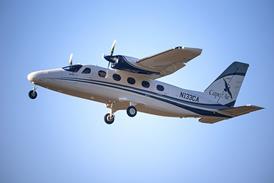
One of the USAF’s new L3Harris-BAE Systems EA-37B Compass Call jets landed at Ramstein Air Base in Germany on 26 January for the first stop of what the Pentagon is calling a “roadshow” for the electronic attack platform.
Other planned stops on the tour include Spangdahlem Air Base in Germany and RAF Mildenhall in the UK. The milestone marks the first time the latest iteration of the Compass Call platform has been introduced to a NATO operator in Europe.
“As it enters operational service, the airframe will deliver decision dominance across all domains going forward,” says Lieutenant Colonel Ronnie Smith, deputy division chief for future operations at US Air Forces in Europe.

Housed in a modified Gulfstream G550 business jet, each EA-37B contains an advanced suite of sensors and missions systems provided by BAE and integrated into the airframe by L3Harris.
BAE says the Compass Call mission package offers long-range, full-spectrum stand-off electromagnetic warfare signals-jamming capability that can be used to disrupt enemy air defences, communications, navigation systems, intelligence gathering and command and control networks.
The USAF took delivery of its first test variant EA-37B in 2023, while the first operationally configured aircraft entered service in 2024 at Davis-Monthan AFB in Arizona.
Current plans call for a total fleet of 10 EA-37Bs, a type that was initially designated the EC-37B.
The modified business jet is replacing an earlier iteration of the Compass Call housed in a Lockheed Martin C-130H transport – designated the EC-130H.
That aircraft saw active service during the US-led war in Iraq, where it disrupted insurgent communications systems and triggered improvised explosive devices.
Fourteen of the C-130-based Compass Calls were fielded, which are now in the process of being phased out.
A key mission for the new EA-37B fleet will be disrupting the ability of an adversary to assemble so-called “kill chains” – the networks of various sensors and weapon systems that combine across the air, maritime, ground, space and cyberspace domains to identify, target and destroy enemy assets.
“One of the most important aspects of success in conflict is information superiority,” says Captain Tyler Laska, an EA-37B pilot with the USAF’s 41st Electronic Combat Squadron at Davis-Monthan.
“Every moment of hesitation that we can implant into an adversary’s decision-making process increases the survivability of our men and women on the leading edge of every domain,” Laska adds.
Italy has also signed on to field at least two EA-37Bs under a 2025 contract with L3Harris worth $300 million.
American export regulators in 2024 approved Rome to purchase up to four of the electronic attack jets.
The stand-off EA-37B is distinct from the stand-in electronic attack capability used for the high-risk “wild weasel” suppression of enemy air defences mission, for which the USAF currently uses a small number of specially outfitted Lockheed Martin F-16CM fighters. The USAF as not operated a dedicated electronic attack fighter since 1998, when the service retired its General Dynamics EF-111A Raven jets – derived from the F-111 Aardvark swept-wing fighter bomber.
Only the US Navy and Royal Australian Air Force now maintain that capability with their fleets of Boeing EA-18G Growler electronic attack fighters.