














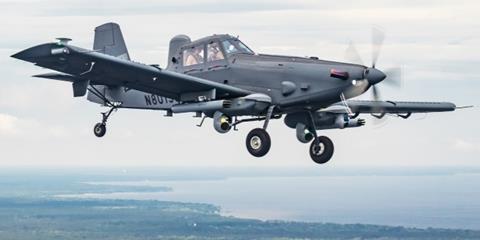
US defence manufacturer L3Harris is looking to significantly expand the capabilities of its SkyWarden close air support turboprop with new weapons and sensors.
L3Harris is under contract with the Pentagon to provide a variant of the SkyWarden for Air Force Special Operations Command (AFSOC) – a light attack configuration designated the OA-1K.
The company currently has signed orders for 39 examples, with a total programme of record covering up to 75 aircraft.
At the 2026 Air & Space Forces Warfare Symposium, L3Harris revealed a number of new initiatives surrounding the armed crop duster, including the addition of a direct fire gun pod, a signals intelligence collection sensor, 226kg (500lb) guided bomb and a new long-range precision missile.
The goal with adding those disparate capabilities is to expand the number of mission sets the SkyWarden can perform within US Special Operations Command (SOCOM) and elsewhere, according to Jason Lambert, president of intelligence, surveillance and reconnaissance for L3Harris.
“This is going to become the Swiss Army Knife for USSOCOM and AFSOC in terms of what we can go field and put on this,” Lambert says, referencing the famously useful brand of bright red multi-tools.
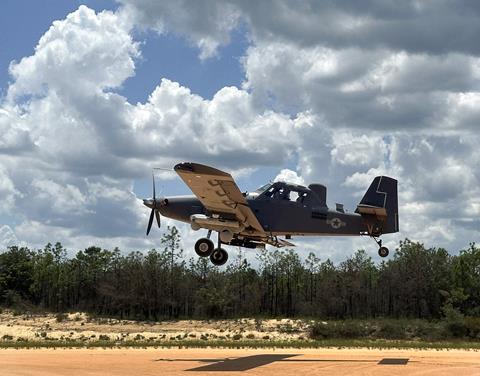
Other lines of effort for the SkyWarden include certifying the type to carry a GBU-12 226kg guided bomb and adding an L3Harris signals intelligence collection pod, which Lambert says was recently demonstrated for Pentagon officials during a flight test event in Melbourne, Florida.
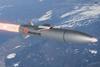
L3Harris is also in discussions with SOCOM to add the company’s new Red Wolf long-range, multi-role cruise missile. That system, which boasts a range of 200nm (370km), is under contract with the US Marine Corps.
In addition to new weapons and capabilities, L3Harris is also working with the US Federal Aviation Administration to expand the flight envelope of the SkyWarden from an 18,000ft operating ceiling to 25,000ft.
That would significantly expand the firepower available to the OA-1K, which was conceived as a stand-in, light attack platform able to operate from austere bases in support of commandos deployed to far-flung locales.
SOCOM began the procurement process for what was initially known as the Armed Overwatch aircraft during Washington’s protracted war in Afghanistan, where NATO forces enjoyed total air dominance.
L3Harris won that competition with a militarised version of Air Tractor’s popular AT-802 crop dusting and firefighting turboprop.
However, the Armed Overwatch programme generated criticism from government auditors: post-Afghanistan, the Pentagon shifted its focus to high-intensity conflict and air combat against a near-peer industrial adversary with modern tactical jets and air defences. In such a conflict an armed crop duster would be woefully outmatched.
Despite that, AFSOC has remained resolute in its support for the OA-1K and recent battlefield developments have opened the door to new use cases.
Western governments are scrambling to find effective defences against mass waves of cheap, slow one-way attack drones, the type which have been fired into Ukraine and Israel in large numbers.
An anti-drone role is also being envisaged for other platforms that have traditionally focused on ground attack. The US Army is honing the counter-UAS capabilities of the Boeing AH-64 attack helicopter, while Embraer envisages a counter-UAS role for the A-29 Super Tucano light attack aircraft.
Such weapons are so numerous that they can quickly overwhelm conventional missile-based air defences. Scrambling high-powered fighter jets is one option, but offers a significant cost disadvantage, while also pulling pilots and aircraft from more specialised missions.
Ukraine has seen success deploying rotary-wing and turboprop aircraft, equipped with machine guns and low-cost rockets, in a defensive counter-UAS role. Such an approach offers significantly lower operating costs, while preserving high performance jets for other missions.
Lambert says L3Harris is in discussions with Ukraine about fielding the SkyWarden equipped with a GAU-19 .50 calibre gun pod. That weapon system is already compatible with the existing hardpoints on the SkyWarden, making for a straightforward integration process.
“It’s just plugging it in and getting it integrated, which is a pretty easy job,” Lambert says of the of all the new systems currently being added to the SkyWarden.
That ease stems from the aircraft’s modular and open-source operating software.
The closed cockpit and high operating ceiling of the SkyWarden make it well suited to a counter-UAS role in Ukraine, according to Lambert. Discussions with Kyiv have revealed that many drone barrages happen at night and in cold weather conditions. Air-to-air intercepts requiring an aircraft that can respond in that environment.
Other counter-UAS-oriented expansions are also being explored for the SkyWarden, including doubling the aircraft’s existing load-out of 35 BAE Systems Advanced Precision Kill Weapon System II laser-guided rockets.
Those low-cost rockets have emerged as the Pentagon’s go-to weapon for shooting down hostile drones when paired with a laser designator like the two Wescam electro-optical sensors featured on the OA-1K.
All that counter-UAS capability, combined with a low sticker price and cost per flight hour, has generated “extremely high” interest in the SkyWarden internationally, according to Lambert.
“The international quantity is going to be at least what the US quantity is,” he predicts. “So, when we look at our capacity planning, I’m planning for double.”
That represents a total addressable market of at least 150 aircraft, although Lambert feels that SOCOM will expand its own order beyond the 75 now projected.
While L3Harris has not yet secured any firm commitments from aboard, the company has an active partnership with Israel Aerospace Industries to market a “Blue Sky Warden” to the Israeli air force.
Lambert says multiple officers from the Israeli armed forces have flown the SkyWarden as part of that effort.
“Those discussions are continuing to evolve,” he notes.
Active production of the OA-1K for SOCOM is underway in Waco, Texas, with deliveries ongoing. L3Harris has a current production capacity of 12-18 aircraft per year, with the ability to surge to 24 based on demand.
AFSOC is in the process of training its first cohort of instructor pilots on the OA-1K.
A non-fatal crash involving one of the turboprops occurred in October 2025 outside Oklahoma City. Both crew walked away from the incident.
Lambert says the results of an investigation into the crash have not yet been made public, but he notes that both AFSOC and L3Harris have resumed flight operations with their respective aircraft.
L3Harris plans to exhibit one of the new turboprops at the annual Special Operations Forces Week conference in Tampa, Florida this May.