














US defence manufacturer L3Harris has unveiled a new family of low-cost munitions designed to deliver a range of battlefield effects over long distances.
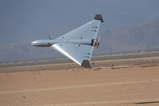
The vehicles fall into an emerging category of weapons called “launched effects”, which combine attributes of cruise missiles, uncrewed aerial systems and sensor packages. L3Harris says its new Wolfpack family of launched effects is designed to be produced at high volumes and to be relatively inexpensive.
The company on 17 July said it is launching the product line with two variants: a long-range kinetic strike munition called Red Wolf and an electronic warfare (EW) version dubbed Green Wolf.
The jet-powered vehicles will be capable of being deployed from a variety of platforms, including fixed- and rotary-wing aircraft, unmanned aerial vehicles (UAVs), ships and ground launchers. Onboard mission software will allow Wolf munitions to travel in swarms and to switch targets.
“Pure chaos [is] what we’re going to develop,” says Matthew Klunder, vice-president for US Navy and Marine Corps accounts at L3Harris.
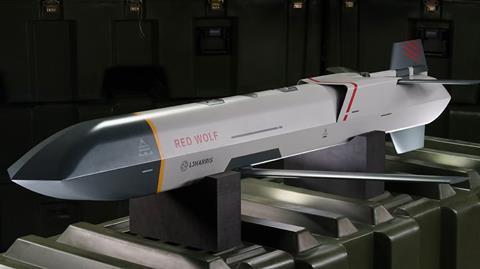
Although L3Harris has been developing such weapons for more than a decade, Wolf comes to market as Western governments seek to field large quantities of precision long-range munitions.
The USA and allies in Europe and Asia face a now well-documented problem when it comes to such weapons, which typically come with a per-unit costs in the millions of dollars and with limited annual production quantities.
Observations from the Russia-Ukraine war led Pentagon officials and defence industry executives to sound an alarm, calling on appropriators in Washington and other capitals to fund expansion of stockpiles. Industry has also responded by developing a new generation of missiles like the Red Wolf specifically designed to be produced in greater quantities and at lower prices.
“We’re five to six times cheaper than what operational Naval Strike missiles today are being offered at,” says Sterling Jones, general manager of L3Harris’ Agile Development Group.
Raytheon’s anti-ship Naval Strike Missile and Tomahawk cruise missile both cost around $1.7 million each, according to analysis from the Center for Strategic and International Studies.
By contrast, Jones says the Pentagon is now targeting a price of $300,000-500,000 for newer generations of precision munitions, depending on range and payload.
“The Red Wolf and the Green Wolf are right within that sweet spot for what the services are looking for,” he notes.
L3Harris has already logged more than 40 flights with Wolf vehicles, some as part of a US Marine Corps test programme. In February, US Naval Air Systems Command disclosed the test firing of a new L3Harris weapon described only as a “long-range precision fire capability”, from a Bell AH-1Z attack helicopter.
That system has now been confirmed to have been a Red Wolf, which was launched and controlled via a tablet. At the time, neither the Pentagon nor L3Harris disclosed details about the weapon.
L3Harris now confirms it has demonstrated that the Wolfs can fly at least 200nm (370km) – significantly farther than precision air-to-ground munitions currently carried on platforms like the AH-1Z.
“Traditional rocket-launched missiles that come off of that platform have single-digit nautical mile range,” Jones notes. “We’re talking about a 20-50-times improvement in the range for that platform, providing a great stand-off distance.”
Other tests have included a high-altitude launch, igniting the Wolf’s subsonic jet engine at 40,000ft.
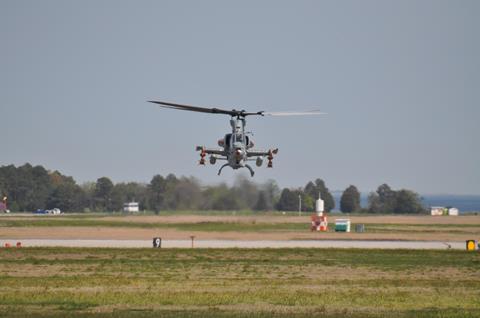
While a single Red Wolf could be deployed like a cruise missile, Klunder envisions swarms of the launched-effect vehicles. They could carry different payloads but operate together to perform complex group tasks.
A single AH-1Z, he notes, can already carry eight Wolf effectors. That allows a single aircraft to deploy a mix of lethal and “non-kinetic” payloads to strike targets and jam air defence communications. With additional Wolf vehicles deployed by other rotorcraft or UAVs, the picture becomes more challenging for enemy forces.
“Now, I’m coming at different vectors on our threat,” says Klunder, who is a retired US Navy fighter pilot and carrier air wing commander.
L3Harris is already in low-rate production for multiple customers on both the Red Wolf strike munition and the Green Wolf EW variant, which the company describes as being equipped with electronic attack and detect, identify, locate and report capabilities.
Jones says the company’s factory in Ashburn, Virginia has capacity to produce thousands of Wolfs annually.
“We see a great applicability of the Red Wolf and the Green Wolf for the demand signals that we’re seeing today,” notes Jones. “This is real. It’s ready. And it is being produced today.”
Subsequent variants in the works include decoy targets meant to confuse and deplete enemy air defence systems, and an airborne communications relay.
Other defence manufacturers are developing and testing similar low-cost, high volume weapons, including Anduril’s Barracuda family of mass-producible cruise missiles and Lockheed Martin’s Common Multi-Mission Truck.