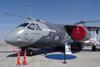













Brazilian airframer Embraer’s company-owned KC-390 demonstrator has in recent months been racking up miles during a sales and demonstration tour.
The twinjet has crisscrossed the globe as part of Embraer’s aggressive push to secure new sales of the multi-role transport, which has seen strong order growth in Europe and Asia over the past two years.
Embraer acquired the aircraft – a former prototype KC-390 – from the Brazilian air force (FAB), which was the type’s launch customer, and converted it into a demonstrator.
A crew of Embraer-employed pilots and loadmasters has been travelling with the aircraft on its world tour, clad in grey flight suits bearing “KC-390 Demonstration Team” patches.
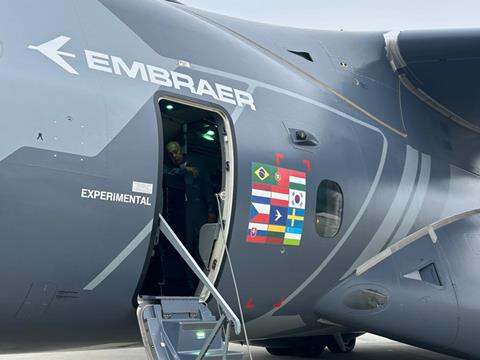
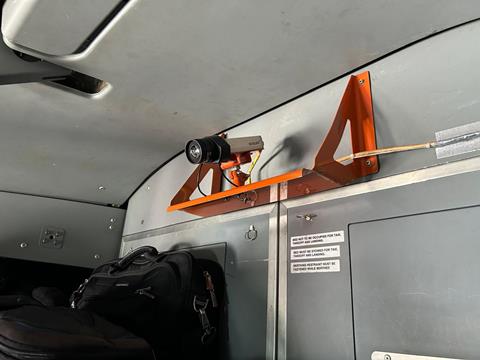
The company-owned KC-390’s fuselage is marked “Experimental” and adorned with Brazil’s flag and those of the 11 countries that have committed to operate the multi-role jet. It has an array of cameras painted in “test orange” throughout its interior.
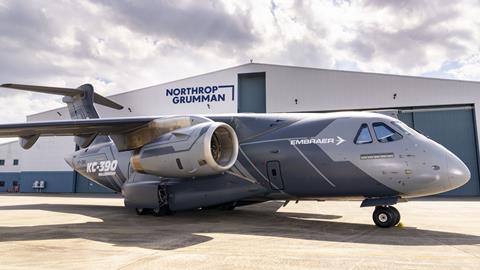
Embraer debuted the aircraft in September 2025. It made its first international appearance at the Dubai air show in November. The company had previously relied on aircraft from the FAB or Portuguese air force for demonstration and media events.
Although the jet (registration PT-ZNG) is ostensibly based in Brazil, it spends more time on the road than at home.
Following its Dubai appearance last November, the KC-390 began 2026 in Brazil before travelling to the Singapore air show earlier this month and touring several other countries in Asia. The jet and crew made stops in the Middle East and Europe with prospective customers before crossing the Atlantic to America.
“That aircraft doesn’t stop,” says Frederico Lemos, chief commercial officer for Embraer Defense & Security.
On 19 February, the demonstrator KC-390 flew a contingent of reporters (including from FlightGlobal) from Washington, DC’s Dulles International airport to Melbourne, Florida as part of a teaming announcement between Embraer and US defence giant Northrop Grumman.
The pair revealed plans to jointly develop a refuelling boom for the KC-390 that would be available as an optional add-on to both new customers and existing operators.
The gruelling schedule of the demonstrator is itself an exposition of one of Embraer’s main pitch points for the KC-390 – reliability.
The jet is notably completing its world tour with a minimal logistics footprint. A pallet of spare parts and supplies, including landing gear tyres, is the only support package travelling with the aircraft, according to Lemos.
“What you saw in the ramp, that’s the support it has for one month of flying all around the world,” Lemos said from the tarmac in Melbourne on 19 February.
The twinjet was designed to be a daily flyer, incorporating features and design principles from commercial airliners.
Embraer is a major global supplier of regional passenger jets and applied that perspective to the KC-390. The tanker-transport features creature comforts not typically associated with similar-sized military transports, including an airliner-style toilet, a pressurised troop and cargo area, and ability to carry business-class seats for VIP transport.
Following its US appearance, the KC-390 demonstration team will return to Europe for further engagements, although Embraer declines to provide specifics of that schedule.
Several European operators are among the 11 countries with commitments for the transport, including the Netherlands, Hungary, Sweden, the Czech Republic and Portugal.
Two KC-390s are already in service with the Hungarian air force, while Portugal’s still-growing fleet sits at four jets, according to data from aviation analytics company Cirium.
During a tour of the aircraft, Lemos points out several of the KC-390’s tactically oriented design features, including a hardpoint attachment for a Northrop multi-sensor Litening targeting pod, and main landing gears with four oversized tyres each.
“This is to reduce the pressure on the runaway, so it is able to land in very soft and unpaved runways,” Lemos notes.
The KC-390’s two International Aero Engines V2500 turbofans are mounted high and close to the fuselage to minimise the chance of ingesting objects while operating from unpaved runways.
Another visually noticeable feature of the Embraer jet are two sponsons located on the ventral fuselage, which house the main landing gear.
Stowing the gear in those outboard compartments allowed Embraer to preserve more usable space in the cargo compartment. This allows for large items like a Sikorsky UH-60 Black Hawk helicopter or an armoured vehicle with turret to be loaded with minimal disassembly.
The extra space also enables the KC-390 to simultaneously carry troops and cargo pallets.
Other features include fly-by-wire flight controls, side-mounted deflection doors for smoother paratrooper drops and a nitrogen injection system to limit the risk of a fuel tank explosion in the event of hostile fire.
Multi-mission hardpoints on the wings can support both hose and drogue aerial refuelling pods and electronic warfare effectors.
“We can even consider installing kinetic effects on those pods for defence or offence type of missions,” Lemos adds.
The KC-390 offers greater-than-typical payload for medium-lift transports: 26t for a concentrated load and 23t for a palletised load.
It can carry up to 80 troops and has a fuel capacity of 35t.