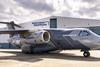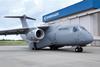







Embraer is giving a worldwide show debut to its new KC-390 demonstrator, with the specially-liveried airlifter proudly displaying the flags of 10 customer nations just behind its forward crew door.
“It is a pleasure to be coming back to the Dubai air show,” says Bosco da Costa Junior, chief executive of the Brazilian airframer’s Defense & Security business unit. “Embraer is bringing the whole portfolio of the company,” he notes, with its presence also to include the E195-E2 regional airliner and the passenger-to-freighter E190F conversion.
“It is a very important, strategic region for Embraer as a group,” he says. “We are expecting a very crowded and productive show, with several delegations confirmed to visit our chalet to discuss projects and sales campaigns.”
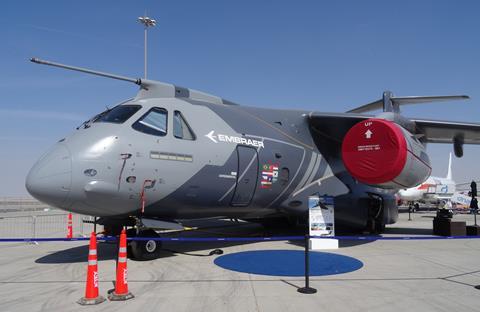
Sporting a striking two-tone grey livery, along with the company’s logo on its tail and KC-390 name on the fuselage underside, the former Brazilian air force prototype was recently acquired by the manufacturer to bolster its marketing activities.
“We decided to transform it, to help us to demonstrate the capabilities of the platform worldwide without disturbing any air force,” da Costa says. “It will be mainly used as an asset to increase sales opportunities around the world.”
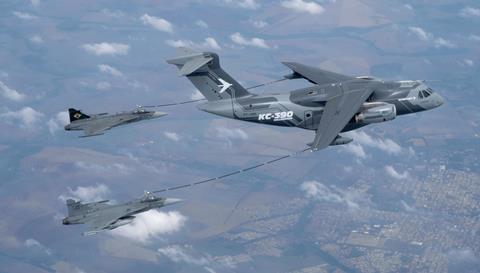
Embraer also will call on the asset to support flight-testing and integration work as required: it recently completed an in-flight refuelling certification campaign also involving a pair of Brazilian air force-operated Saab Gripen E fighters.
Its domestic customer has so far taken delivery of eight KC-390s, with the launch operator to eventually have a 19-strong fleet. Total deliveries to date stand at a dozen examples of the tactical transport and tanker, with other recipients being Hungary (1) and Portugal (3).
So far this year, Embraer Defense & Security has handed over two of the twinjets: one each for Brazil and Portugal. Before the end of 2025 it also will deliver Hungary’s second example, completing that nation’s buy, along with Lisbon’s fourth of six.
Final assembly work is also nearing completion on the first of three examples ordered by South Korea – its current lone buyer in the Asia-Pacific region. However, while that jet will be flown for the first time before the end of December, it will then be handed over to Embraer’s engineering team, which is to integrate customer-specific items including additional communications equipment.
Seoul’s lead C-390 will be flown to the customer nation before the end of 2026, da Costa says.
Embraer’s remaining firm contracts for the Millennium are with Austria (4), the Czech Republic (2), the Netherlands (5), and Sweden (4). The identity of another confirmed buyer, which will take two units, remains undisclosed.
Lithuania and Slovakia, meanwhile, each have expressed their intention to buy three, with deals yet to be finalised. “The conversations are moving well with those two countries,” he says. “They know the value that the C-390 could add to their air forces.”
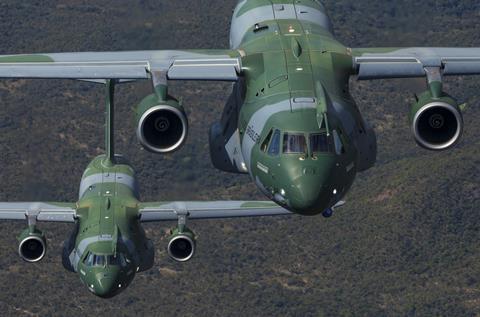
Embraer is in the process of ramping up manufacturing activities to keep pace with demand. Its output will rise to six of the International Aero Engines V2500-powered type next year, before hitting an annual rate of 10 during 2030.
“We have a strong backlog, and a strong plan to deliver our platforms on time, according to the contracts that we have signed,” da Costa says.
“Our production line is running completely perfectly, on time, and in a very professional and lean way. We are ramping up, and the operations of Embraer and our supply chain are 100% engaged with this product.”
Asked how he views the market potential among the Gulf states – notably, Saudi Arabia and the United Arab Emirates are each operators of aged Lockheed Martin C-130Hs – he says: “The Middle East is running out of this capability, and we see a very aged fleet of tactical transport and tactical multi-mission platforms.
“They will need to take a decision in a very fast way about the replacement,” he suggests. “The C-390 is ready – the airplane is proving its value and delivering unmatched availability rates. I think we have the conditions to have in the near future some news around the Middle East. I hope we could have some C-390s flying here in a fast way.”
With industrial participation and the local provision of in-service support likely to be factors in any such sale, he states: “We would like to invest in the region and increase the Embraer network. I hope the first [C/KC-390 customer] country will be our hub in the region.”
Embraer is not alone in eyeing opportunities to refresh fleets in the region, with other candidates being the Airbus Defence & Space A400M and Lockheed’s C-130J.
Da Costa declines to identify individual sales targets, noting: “I think the C-390 could play a role in every single country worldwide. I have some advanced conversations with some countries… but we would like to be everywhere. I would like to expand the footprint of Embraer defence on a global perspective.”
Another of his objectives is to secure commitments from the US military, especially eyeing the potential to supply a derivative equipped with a lightweight in-flight refuelling boom.
Studies are ongoing around this addition, along with the required integration of other US-specific mission equipment, with Embraer also pledging to establish an in-country final assembly line if selected.
With a teaming agreement having been announced with the US prime earlier in June, he says: “Northrop [Grumman] is one of the possibilities” for a partnership around future sales.
Currently employed by the Brazilian air force, the KC-390’s existing tanker capability is provided via the use of under-wing hose and drogue refuelling pods.
Recently conducted from Embraer’s Gaviao Peixoto site and involving personnel from the airframer, Saab and the air force, the certification activity with the locally-named F-39E involved “a range of flight configurations, speeds and altitudes”, and “confirmed precision during in-flight refuelling”.
That work involved “verifying the compatibility of both aircraft across the KC-390’s entire flight envelope, for high-speed refuelling under both day and night conditions”, Embraer says. That included the tanker simultaneously passing fuel to two single-seat F-39Es.
Describing the flight trials process as having been “very smooth and very successful”, da Costa says: “It is demonstrating even more the capability and how the C-390 is easy to integrate in any air force around the globe.”
Meanwhile, the first F-39E to be built on a joint production line at Embraer’s Gaviao Peixoto facility is at an advanced stage ahead of its handover during 2026, he reveals.
“The airplane is already at a final stage on our assembly line, and about to finish the painting process. I hope that no later than the beginning of the second quarter we are going to deliver it to the Brazilian air force.”
The service has around 10 F-39Es in use, with the Gripens being acquired via a deal for 28, plus eight twin-seat F-model jets.
Embraer is looking forward with pride to the coming delivery event, with da Costa noting that it will be “the first supersonic fighter produced in South America”.
Saab also will be happy with the development, with the airframer currently exploring means of significantly boosting its annual output of the Gripen at its Linkoping site in Sweden, Brazil and potentially another new hub.
That stems from Ukraine’s recent signature of a letter of intent seeking a buy of potentially 100-150 examples wanted from late this decade. And Saab on 15 November announced its receipt of a contract from Brazil’s neighbour Colombia to also field 17 Gripen E/Fs.
“Our relationship with Saab and Sweden is at an outstanding level,” da Costa says. “I am in touch very often with [Saab chief executive] Micael Johansson, talking about the collaboration and plans around Gripens and C-390s.
“They are exploring possibilities to increase the rate on our production line. Saab is seeing the quality of our assembly line and the quality of our process and level of lean manufacturing that we have implemented in Brazil.
“We are 100% ready to help them to increase their rates, to increase the number of Gripens around the globe. We know that there are some possibilities, and we exploring those.”