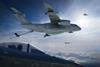













Brazilian airframer Embraer and US defence manufacturer Northrop Grumman are teaming up to add an in-flight refuelling boom to Embraer’s KC-390 multi-role tanker.
The pair announced their new partnership on 19 February in Melbourne, Florida, where both companies have substantial engineering workforces.
The goal of the new initiative is to develop an optional boom system for the KC-390 capable of autonomously connecting with receiver aircraft to offload fuel in flight. That would significantly expand the roster of aircraft the KC-390 is able to support with aerial tanking.
Currently, the Embraer multi-role jet conducts in-flight refuelling using the probe-and-drogue system favoured by the US Navy and US Marine Corps.
However, the US Air Force exclusively uses the boom method for topping off its fighters, bombers and transports, with tanking platforms like the Boeing KC-135 and KC-46 built around a fuel transfer boom mounted on the ventral fuselage of the tail section.
Several prolific fighter types, including the Lockheed Martin F-35A, Boeing F-15 series, and Lockheed Martin F-16, all take on fuel via a boom.
The F-16 is the world’s most numerous fighter aircraft, with more than 2,000 examples in service globally, according to data from aviation analytics company Cirium. Theere are just under 900 F-15s in service globally, while Lockheed has shipped more than 1,300 F-35s – although some of these a the B- and C-variants which use the probe-and-drogue refuelling system
Adding a boom refuelling option to the KC-390 would open up those fleet operators as potential customers for Embraer, significantly expanding the potential base for new orders.
“We’re going to position this platform to be even stronger,” says Bosco da Costa Junior, chief executive of Embraer Defense & Security.

Eleven countries have signed on to operate the Embraer tanker-transport, with 15 examples in service with Brazil, Portugal and Hungary. Embraer also operates its own company-owned KC-390 demonstrator for prospective customer visits and air shows.
Despite no firm orders for a boom-equipped KC-390, nor government funding to support development, both Embraer and Northrop see significant potential upside to the endeavour.
“We think it’s going to have great returns,” says Tom Jones, president of Northrop’s aeronautics division.
While the US Air Force is the white whale of potential new tanker business (the service operates a growing fleet of more than 530 refuellers) executives from both companies say they are not banking on USAF orders to make a KC-390 boom programme viable.
“I believe there’s going to be a lot of international demand for this,” Jones says.
Frederico Lemos, chief commercial officer for Embraer Defense & Security, seconds this upbeat view.
Whether that international demand will be sufficient to power the KC-390 boom project through a lengthy, and costly, development period remains a matter of debate.
A previous partnership between Embraer and L3Harris to bring a so-called “agile tanker” KC-390 variant to the US market collapsed in 2024 after two years of work yielded little progress toward a sale to the USAF.
That project envisioned L3Harris as the prime contractor for a KC-390 derivative featuring a refuelling boom and US-specific mission systems.

The USAF’s plans for recapitalising its ageing fleet of KC-135s have repeatedly shifted in recent years, with the service opting to double down on the troubled Boeing KC-46 – although some lawmakers in Congress oppose that tack, owing to engineering shortfalls on the Boeing tanker.
Senior air force leaders have expressed more interest in developing a new stealthy tanker platform than purchasing a smaller, agile tanker like the KC-390 – despite the service’s new-found focus on distributed operations from smaller airfields under the Agile Combat Employment concept.
“The legacy tanker fleet faces a lot of challenges,” Lemos notes. “They are not fit for that mission.”
Even with the doubtful nature of potential US Air Force orders, Northrop still sees value in pursuing the boom capability.
“If we only focus on the domestic market, we’re missing a much bigger picture of opportunity that is out there,” Jones says.
While both companies decline to offer specifics on the timeline to having an offering ready, Jones says they aim to have a demonstrator ready in “low, single-digit years”.

The vision for the new boom is as an optional add-on that preserve the existing multi-mission capabilities of the KC-390, including access to the twinjet’s rear cargo ramp.
Embraer says its goal is to make the boom available to both new customers and existing KC-390 operators as a retrofit.
The company notes that its new partner already has some familiarity with the Brazilian made jet, with Northrop already on contract to integrate NATO communication systems into the KC-390s flown by NATO members.
Northrop is already working with Embraer to integrate NATO communication systems into the KC-390 for NATO operators
Should any orders from the Pentagon materialize, Embraer says it remains open to opening a domestic production line for the KC-390 in the United States – a position the company has stated previously.