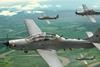














Embraer will promote the A-29 Super Tucano light-attack aircraft as a counter-unmanned air systems (UAS) platform, citing the type’s weapons loadout and sensor capabilities.
The company observes that the Super Tucano’s electro-optical/infrared sensor can track and designate UAS, and that the aircraft can engage them directly with laser-guided rockets as well as with its pair of .50-calibre machine guns.
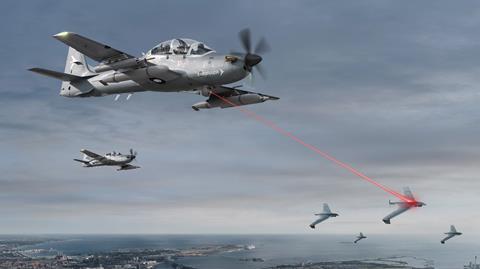
Moreover, its datalinks can receive target coordinates.
“We continue to expand the A-29’s capabilities to address the most recent challenges faced by many nations worldwide,” says Bosco da Costa Junior, president and chief executive of Embraer Defense & Security.
“The continued challenges in modern warfare and the recent conflicts worldwide have shown the urgent need for solutions to fight drones. The A-29 is the ideal tool to counter UAS effectively and at low cost, adding to the aircraft’s already extensive mission set that includes close air support, armed reconnaissance, advanced training, and many others.”
Extensive footage has emerged on social media of Ukrainian helicopters using machine guns to shoot down Russian one-way attack drones, such as the Iranian-designed Shahed.
The Super Tucano is also equipped with the BAE Systems AGR-20 Advanced Precision Kill Weapon System (APKWS), a laser guidance kit for the Hydra 70 rocket.
APKWS has been shown as an effective, low-cost weapon for downing UAS, offering precision strike capability at roughly one-third the cost of traditional missiles.
In March, the US Military’s Central Command released a video of APKWS rockets destroying one-way strike munitions launched by Houthi militants in Yemen.
At June’s Paris air show, US Marine Corps Brigadier General David Walsh, the US Navy’s programme executive officer for several rotorcraft types, said that the Sikorsky MH-60R also enjoyed success using APKWS against UAS employed by the Houthis.
As for the Super Tucano, the type’s low stall speed of around 43kt (80km/h) means it can efficiently engage drones with slow cruising speeds, allowing it to match pace with targets that faster jets would struggle to intercept. The type can also operate from austere locations.