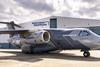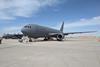












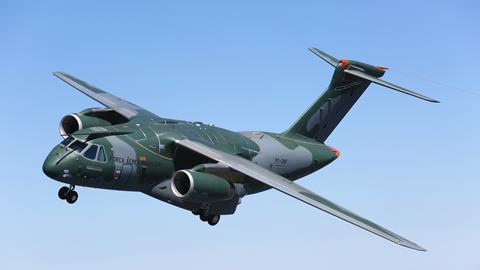
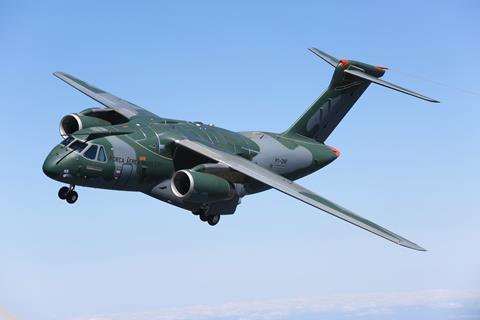
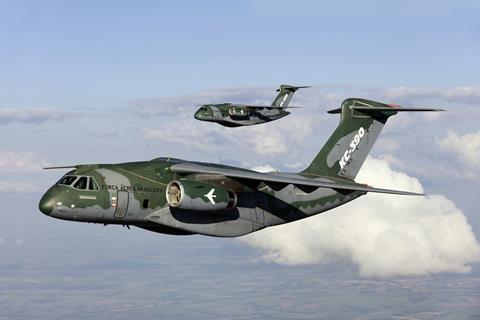
Brazilian airframer Embraer is developing a plan for local assembly of its marquee KC-390 Millennium tanker-transport as part of a bid to secure a next-generation refueller contract with the US Air Force (USAF).
Embraer tells FlightGlobal it already has site plans developed at multiple locations across the USA that could support KC-390 production, should the company be selected to provide tankers to the US service.
“[We are] 100% committed to that, to invest more in the US,” says Frederico Lemos, chief commercial officer for Embraer Defense & Security.
Lemos spoke with FlightGlobal at the Air & Space Forces Association (AFA) conference in Washington, DC in September.
Although currently assembled at Embraer’s Sao Paolo state industrial hub in Gavio Peixoto, Brazil, Lemos notes that each KC-390 aircraft already contains a high level of US-produced content.
US aerospace manufacturers already supply numerous critical systems for the Millennium twin-jet, including avionics, engines, the auxiliary power unit, flight control surfaces and the cargo handling system.
Propulsion consortium International Aero Engines provides the KC-390’s twin V2500 turbofans, while more than 90 other components and subsystems are supplied by Collins Aerospace, L3Harris, Raytheon, BAE Systems and others.
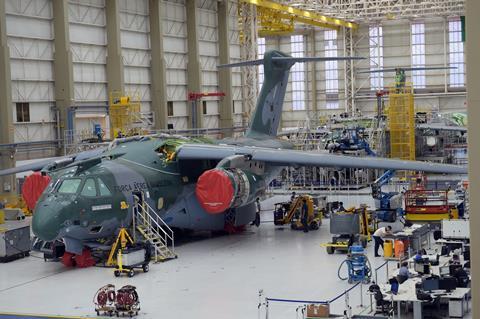
Embraer says 59 US-based aerospace firms contribute to the KC-390, accounting for over 50% of total purchased materials that go into each jet.
Local assembly in the USA would make the multi-role tanker compliant with the Buy American Act, which generally requires the federal government to source its procurement needs domestically.
As far as where Embraer might locate KC-390 production in the USA, Lemos says those discussions are ongoing. Much of the defence aerospace industry is waiting for the USAF to finalise its requirements for a future tanker platform, which Lemos says will influence considerations around programme logistics and workforce expertise.
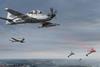
The airframer already has a substantial production presence in Florida, completing final assembly of business jets in Melbourne and the light attack A-29 Super Tucano turboprop in Jacksonville.
Embraer also maintains MRO facilities in Arizona, Texas and Florida.
TANKER INDECISION
The USAF is currently in the process of replacing its aged Boeing KC-135 tankers with the newer Boeing KC-46A.
While that succession can address the life cycle issues with the decades-old KC-135, air force leaders say it will also need another new tanker platform – one that can survive against modern threats.
This broad concept is known as the Next Generation Air refuelling System (NGAS), and the USAF’s top generals say they are open to a wide range of potential solutions for a so-called “survivable tanker”.
NGAS was originally envisioned as a purpose-built stealth aircraft, likely using a blended-wing body configuration, when the programme launched in 2023.
Concerns about potential cost and development times had seemingly led the USAF to back off from that concept at the start of this year.
The two-star general in charge of force design and integration suggested in March that the air force could perhaps achieve a survivable aerial refuelling capability with a “systems-based approach” rather than a bespoke stealth tanker.
That could involve using electronic warfare to better conceal a conventional refuelling aircraft, perhaps combined with advanced air-superiority capabilities like in-development uncrewed fighters or a future sixth-generation aircraft.
However, at the more recent AFA conference, the general in charge of the USAF’s tanker fleet said the service is still open to considering any solution to the survivable tanker problem.
“Just about every option is on the table,” said General John Lamontagne, head of Air Mobility Command (AMC), which oversees both aerial refuelling and transport squadrons.
That includes a clean-sheet, blended-wing body stealth design, a converted business jet or a “signature-managed” conventional tanker.
It will likely also include a US-specific variant of the KC-390.
“There is a request for information [RFI] out there and we will be responding to it,” Lemos says.
The air force released a non-binding RFI to industry in August, seeking ideas for NGAS concepts. Responses are due by 24 October.
Additional comments by Lamontagne indicate the USAF is still wary about the costs of a bespoke stealth tanker, which could give a boost to Embraer – with its active production line and mature design that is already being fielded by multiple NATO members.
“We see that the 390 can play a role for that mission,” Lemos says.
“The capabilities today already make it very survivable,” he adds. “The speed and the height that it can fly, but also the systems that it has, not only in terms of self-protection, but also the connectivity that allows it to receive information and disseminate information to avoid potential areas of higher risk.”
Lemos says a KC-390 pitch for the USAF would also likely include additional electronic warfare protective measures and unspecified kinetic effects geared toward further enhancing survivability.
“It has already a very high level of survivability,” he notes. “But considering what we are seeing in terms of threats, we can complement with other things, if the US Air Force sees that other capabilities are required.”
Embraer in 2022 teamed with US defence contractor L3Harris to offer a “tactical tanker” variant of the KC-390 to the Pentagon, which the airframer dubbed the “Agile Tanker” concept.
While that partnership is no longer active – likely the result of repeated changes to the USAF’s tanker modernisation strategy – that early work on the Agile Tanker configuration appears to have laid a foundation for Embraer’s current plans.
The company is certain to face stiff competition for any NGAS contract that does emerge from industry heavyweights potentially including Boeing, Lockheed Martin, Airbus and others.
Systems integrators L3Harris and Sierra Nevada have both developed strong lines of business converting executive jets into military platforms, and may also jump into the fray.
While the future of the NGAS programme remains nebulous, amid a tight budgetary environment and numerous competing priorities for modernisation funds, air force leaders are adamant they need a tanker that can operate in airspace that is far too dangerous for the current fleet of refuellers.
“We’ve got to be able to go into much-higher threat environments,” AMC commander Lamontagne says.
Absent a survivable stand-in tanking option, the four-star general says the air force would need to develop new extreme long-range precision weapons that can allow bombers and tankers to remain far outside an adversary’s engagement zones.
Despite the rhetorical commitment to NGAS, the programme’s future remains nebulous.
Air force leaders have previously said they want to field a new aircraft by the mid- or even early 2030s.
Against that short development timeline, fiscal year 2026 budget request included just under $13 million to support NGAS development. That represents only a slight increase from the $7 million listed in FY2025.
The request comes at a time of immense competition for fiscal resources within the air force.
Major – and already active – procurement efforts including the Boeing F-47 sixth-generation fighter, Northrop Grumman B-21 stealth bomber and Sentinel intercontinental ballistic missile recapitalisation are all demanding substantial investment of limited modernisation dollars.
The USAF is also being challenged to meet ever-increasing demand for both tactical air power and air mobility support with a fleet of ageing aircraft that has shrunk significantly since the end of the Cold War.