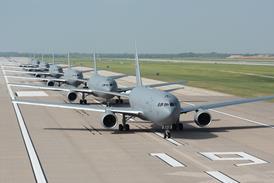













Boeing has signalled progress with updating the KC-46 Pegasus tanker’s remote vision system, as it continues to look for sales opportunities in the Middle East.
The company has just flown the first KC-46 equipped with the new Remote Vision System 2.0 (RVS 2.0), says Steve Parker, chief executive for Boeing Defense, Space & Security. The flight took place despite rainy weather conditions in Seattle.
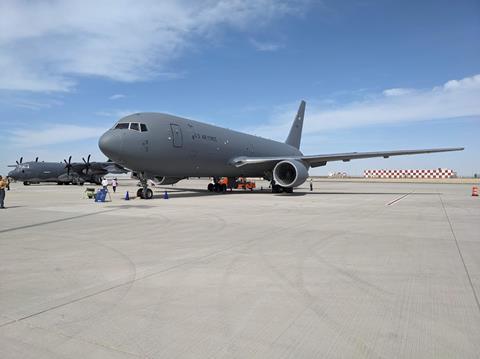
“That’s a huge milestone for the programme,” says Parker. “So, we’ll go into testing now and into 2026, and we’ll do contact testing eventually as well.”
RVS 2.0 aims to resolve issues with the aircraft’s existing system, which can be challenged by image distortion and poor responsiveness in changing light and shadows. This can result in boom operators misaligning the boom or even damaging receiving aircraft.
Unlike the KC-135, where the operator lays on his stomach and looks through a large window to guide the boom, the same process on the KC-46 is performed using a console in the cockpit. This improves ergonomics and crew communications but requires a robust remote vision capability.
Parker adds that KC-46s coming of the production line in Seattle are equipped with RVS 1.5, which he says is “exceptional”.
Parker made the KC-46 remarks at a media roundtable prior to the Dubai air show. He was joined by Bernd Peters, vice-president of business development and strategy for Boeing’s defence unit.
Peters declines to discuss specific KC-46 market opportunities in the Middle East but notes that the US military operates the type in the region. This offers potential customers a glimpse into its capabilities.

Qatar is known to be a potential customer. In May, US President Donald Trump said an agreement had been signed for Qatar to obtain $42 billion in US defence equipment, including KC-46 tankers.
“I do think there is more opportunity in the region outside of Qatar for the KC-46, and at the appropriate time we’ll be able to discuss that,” adds Peters.
Parker also notes that the USAF has confirmed an acquisition of up to 75 additional aircraft. Boeing also emphasises that the Pegasus can act as a “smart node” in airborne networks.
Throughout the briefing, Parker stressed that Boeing is focused on executing on its programmes. This emphasis stems from the significant delays and challenges suffered by programmes such as the KC-46 and T-7 advanced jet trainer.
“From a Boeing Defense, Space & Security perspective, it is around driving stability and performance into our production and development programmes