










The US Air Force (USAF) is eyeing a role for Boeing’s F-15E strike fighter in defending against swarms of lethally-armed enemy drones.

The Air Force Test Center on 3 September revealed it has successfully integrated BAE Systems’ Advanced Precision Kill Weapon System II (APKWS II) rockets onto an F-15E, and has completed multiple live-fire demonstrations.

Notably, the flight test portion of the effort was completed in just nine days, according to air force officials, a drastic reduction from a usual 18-month timeline.

Perhaps even more significantly, frontline F-15Es began flying with APKWS II rocket pods in an unspecified region within one week of demonstrations.

“We made it a top priority to field this new capability as quickly and safely as possible,” says Brigadier General Mark Massaro, commander of the USAF’s 96th Test Wing.

F-15 with AGR-20F APKWS II rockets c USAF

Source: US Air Force

A US Air Force F-15E multi-role fighter launches a BAE Systems ARG-20F laser-guided rocket, which have become the weapon of choice for defending against small, lethally armed drones

Images released by the Air Force Test Center show an F-15E carrying six APKWS II rocket pods, with each underwing weapon station bearing a cluster of three pods.

That mounting system had to be created especially for Strike Eagles, according to Colonel Alec Spencer, director of the Seek Eagle office that evaluates aircraft-store compatibility for the USAF.

“An already-proven way to mount the rockets onto an F-15 did not exist,” Spencer says.

APKWS rockets c US Army

Source: US Army

The Pentagon recently inked a $1.7 billion deal for up to 55,000 APKWS II rockets

The integration team ended up using a 1970s-era triple ejector rack, which allows for three weapons systems to be affixed to a single hard-point. These were paired with legacy LAU-131 launchers to fire the actual rockets.

The hardware was returned to frontline service after being diverted from the USAF’s “boneyard” at Davis-Monthan AFB in Arizona, where decommissioned aircraft are stored either for future use or as a source of spare parts.

After achieving physical integration of the APKWS II rockets with the F-15E, the test team had to develop a communication solution to connect the weapons with the fighter’s fire control system.

Bucking normal protocol, air force test engineers conducted multiple airworthiness evaluations simultaneously with weapon demonstrations – reducing the certification campaign to just nine days.

The USAF test centre cites the “increasing operational need for this weapon” as the reason for the accelerated process. The integration effort was completed in May, the air force now reveals.

Designated the AGR-20F within the US inventory, BAE’s laser-guided APKWS II rocket has emerged as one of the Pentagon’s preferred weapons for defending against swarms of cheap and lethally armed uncrewed aerial systems (UAS) that have been launched against Ukraine, Israel, and US Navy ships in the Red Sea.

Iranian-sourced HESA Shahed-136 drones in particular have emerged as a favourite weapon for long-range strike – one for which the US military did not initially have an easy answer.

Each Shahed has range of 1,350nm (2,500km), according to the Pentagon, with maximum airspeed of 100kt (185km/h). The craft are relatively small, with a 2.5m (8ft 2in) wingspan and weighing around 200kg (440lb).

A February estimate from the Center for Strategic and International Studies puts the cost of each Shahed at around $35,000 – a fraction of the $1-2 million price tag associated with the short- and medium-range guided missiles used to down them.

Each AGR-20F rocket also costs around $35,000, making the weapon an ideal munition for targeting Shaheds, achieving economy of force and preserving larger, more-capable missiles for more-capable targets like fast-moving jets and ballistic missiles.

The US military is rapidly expanding its inventory of the 70mm (2.75in)-diameter APKWS II rockets, recently signing a $1.7 billion contract with BAE for the delivery of 55,000 munitions.

That represents a significant expansion over previous orders. BAE’s website claims it can produce up to 20,000 APKWS IIs annually and has delivered more than 50,000 of the munitions.

“We are prepared to meet increased demand,” the company notes.

F-15E with APKWS II AGRO-20F guided rockets c USAF

Source: US Air Force

Test engineers devised a new mounting system to equip F-15Es with APKWS II rockets, using a Vietnam-era triple ejector rack and external rocket pods

The air force says the goal of its expedited push to integrate the AGR-20F with F-15Es is to bring the twin-engined strike fighter “into the counter-unmanned aerial system fight in a cost-effective way”, alongside the service’s Lockheed Martin F-16 fighters.

The smaller F-16s have been equipped with APKWS rockets as far back as 2016. However, the USAF only recently began deploying those jets in a counter-UAS capacity.

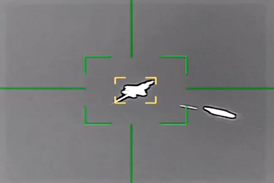
In March, US Central Command released gun camera footage showing an F-16 using an AGR-20F rocket to down a one-way attack UAS launched by Yemen’s Houthi militant group.

BAE’s website lists the F-16, Boeing F/A-18, Fairchild Republic A-10 and Boeing AV-8B as the fixed-wing fighters certificated to carry AGR-20F launch pods.

Numerous rotary-wing platforms and smaller fixed-wing types, such as the L3Harris OA-1K SkyRaider II, can also be equipped.

APKWS rockets are also fired by ground-based counter-UAS systems, such as the truck-mounted L3Harris Vampire.