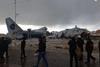













A battle is heating up in Washington, DC over proposed legislation intended to address safety risks exposed by the January 2025 midair collision between a PSA Airlines regional jet and US Army Sikorsky Black Hawk helicopter.
In recent days, Congress has been considering two bills, both of which have supporters and detractors. The prime sticking point has been requirements related to the ’In’ function of ADS-B (automatic dependent surveillance broadcast) – technology intended to help improve pilots’ and controllers’ situational awareness.
On 26 February, the US National Transportation Safety Board (NTSB) made its voice heard, raising concerns about the latest bill to be considered – the so-called ALERT Act.
“We cannot support the ALERT Act in its current form because it is not fully responsive to the NTSB’s recommendations,” the agency said in a letter to top House of Representatives lawmakers.
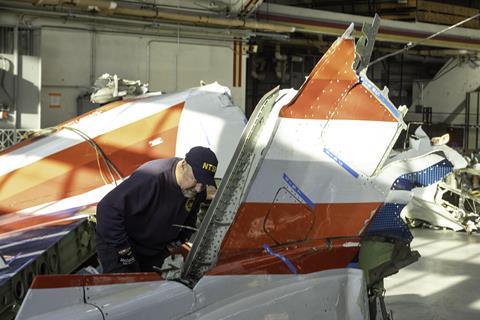
The NTSB had, in its report into the collision, recommended that aircraft be required to have ADS-B In. Aircraft must already carry ADS-B Out, which transmits the aircraft’s position to air traffic controllers and to other aircraft – but only those equipped with ADS-B In.
The US Senate had in December passed the ROTOR Act, a bill sponsored by Republican Ted Cruz that would have mandated ADS-B In. That bill had strong support, including from the Air Line Pilots Association.
But on 24 February the US House voted down the ROTOR Act. Opposition mostly came from Republicans, with House transportation committee chair Sam Graves expressing concern about the technology’s maturity and warning a mandate could cause an “operational crisis”.
One NTSB board member – Todd Inman – expressed similar concerns in the accident report, citing “technological barriers to implementing ADS-B In into the 5,500 commercial aircraft that are in the skies at any given moment”.
Attention in Washington has now shifted to the House’s competing ALERT Act, which has some form of an ADS-B In mandate and whose backers say addresses all 50 recommendations in the NTSB’s accident report.
The ALERT Act would require some aircraft to have Airborne Collision Avoidance Systems (ACAS) – an evolution of the Traffic Alert and Collision Avoidance Systems (TCAS) already found on large jets.
It specifies that ACAS would need to be programmed to “improve alerting throughout more of the flight manoeuvring envelop”, the Transportation Committee says.
Nonetheless, the ALERT Act retains a form of ADS-B In mandate, but would allow compliance using “portable” ADS-B In receivers. Such units can only receive signals that are within line-of-sight to aircraft transmitting ADS-B Out – and the aircraft’s fuselage can also block signals.
ALERT Act backers include Airlines for America, the Aircraft Owners and Pilots Association, the National Business Aviation Association and other industry groups.
But the NTSB is not on board. “While we believe that the bill would address a few of our recommendations, many key provisions fall short,” says the agency’s letter, addressed to four top House lawmakers.
“This includes requiring all aircraft operating in airspace where ADS-B Out is required to also be equipped with ADS-B In.”
The 29 January midair collision killed all 67 people on both aircraft.
A previous version of this story said the ALERT Act has no ADS-B In mandate; it does have such a mandate, though permits more exceptions.