






New Zealand investigators have determined that a Jetstar Airbus A320 was damaged during a taxiway excursion at Christchurch, after the captain inadvertently advanced the thrust levers to ‘climb’ power after vacating the runway.
While en route from Auckland on 31 May 2024, the aircraft had suffered a yellow-circuit hydraulic failure which disabled systems including the right-hand engine’s thrust-reverser, the nose-wheel steering and some of the spoilers.
After touching down on Christchurch’s runway 02 the crew aimed to vacate at the rapid-exit A4 taxiway, using differential braking since nose-wheel steering was unavailable.
The captain armed the thrust-reversers and pulled both thrust levers back to the ‘maximum reverse’ position. Owing to the hydraulic failure, only the left-hand reverser – as expected – deployed.
This partial reverse thrust, along with autobrake, assisted with the deceleration to about 75kt and the captain then applied manual braking.
The aircraft remained on the centreline through rudder control and, as rudder authority lessened, differential braking enabled the crew to maintain alignment.
Once the jet slowed below 70kt, the captain pushed the thrust levers forward to ‘reverse idle’. But about 4s later the captain, intending to select ‘forward idle’ power to taxi, instead advanced the thrust levers to the ‘climb’ setting.
This stowed the thrust reversers. But as the aircraft turned off the runway onto the rapid-exit taxiway, the crew heard the engines spool up and the groundspeed increased from 28kt to 40kt.
New Zealand’s Transport Accident Investigation Commission says the captain was “likely startled” by the engines’ acceleration, and responded by pulling the thrust levers back to the ‘maximum reverse’ setting.
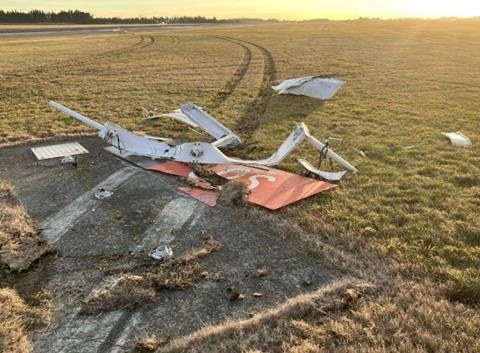
This deployed the functioning left-hand reverser alone and resulted in asymmetric thrust that yawed the A320 to the left and caused it to veer off the left edge of the taxiway. The jet travelled across grass, turning back towards the runway, and its right-hand engine struck a movement-area guidance sign before the jet came to a halt on the runway edge.
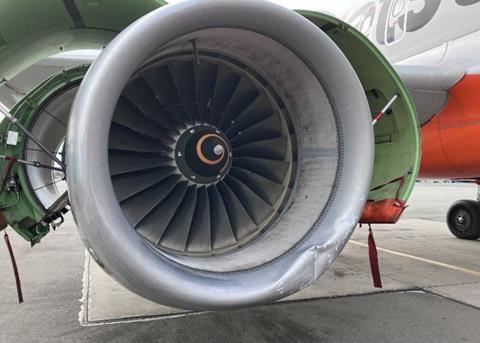
Although none of the 169 passengers and six crew members was injured, the right-hand powerplant – an International Aero Engines V2500 – suffered “significant” impact damage to low-pressure fan blades and the cowl, says the inquiry.
Investigators state that the captain was probably under a “high cognitive load” and working under “conditions of stress”.
Although the thrust-lever positions are presented on engine displays and the thrust position is marked on a scale next to the levers, the pilots did not notice because “their attention was directed outside the [aircraft] and focused on steering,” says the inquiry.
“Both flight crew were likely to have experienced attention-tunnelling that precluded them from perceiving wider information, including the position of the thrust levers,” it adds.
The hydraulic failure was traced to a rupture in a high-pressure titanium alloy pipe which passed through the right-hand main landing-gear bay.
This pipe was found to have been slightly flattened along part of its circular cross-section – probably from damage in transit between two Airbus warehouses in 2015, some nine years before the incident – and is likely to have cracked under repetitive hydraulic pressurisation.
According to the investigation commission, Jetstar has since amended guidance to pilots while Airbus has accepted a recommendation to revise aircraft manuals – during April-May this year – to mitigate the risk of crews’ moving thrust levers to unintended positions.