













The US Federal Aviation Administration has issued a general notice suspending the use of visual separation between fixed-wing aircraft and helicopters in busy airspaces, mandating that air traffic control (ATC) use radar to maintain lateral and vertical separation between such aircraft.
Announced by US Transportation Secretary Sean Duffy and FAA Administrator Bryan Bedford on 18 March, the “upgraded safety protocol” is the result of a year-long FAA-led safety review in the aftermath of the mid-air collision between a US Army helicopter and a PSA Airlines regional jet on final approach to Ronald Reagan National airport in January 2025.
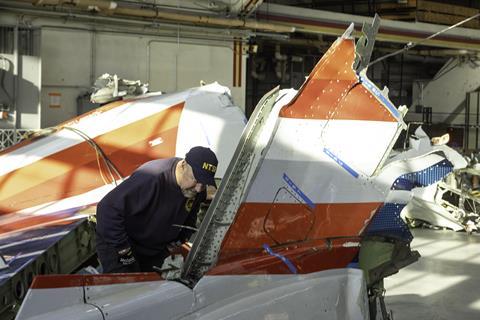
Sixty-seven people were killed in the incident, during which a Sikorsky UH-60L Black Hawk operated by the US Army collided with a PSA Airlines MHI CRJ700. Both aircraft plunged into the icy Potomac River.
The helicopter in the incident was found to be operating outside a mandatory flight ceiling for the Potomac River route while pilots were using night vision goggles that restricted their field of view. A digital recreation by the US National Transportation Safety Board indicates that the UH-60L would have been barely visible to pilots aboard the CRJ700 until a collision was unavoidable.
“The tragedy over the Potomac one year ago revealed a startling truth: years of warning signs were missed, and the FAA needed dire reform,” Duffy says. “Since then, we’ve implemented numerous changes to protect the skies over our capital and keep the travelling public safe. But the job isn’t done.”
Changes have included restricting traffic on the helicopter corridor along the Potomac River, which was identified as hazardous for inbound commercial jets.
Bedford adds that that the FAA is working to ”pro-actively” manage aviation safety risks before accidents happen, including those involving potential helicopter incursions in the flight path of commercial aircraft.
”We identified an over-reliance on pilot ‘see and avoid’ operations that contribute to safety events involving helicopters and airplanes,” he says.
Pilots rely on visual separation when ATC advises them to stay visually clear of nearby aircraft. The FAA says that visual separation “was not enough of a safety mitigation tool” in high-traffic airspaces.
In the Potomac River crash, running lights from both of the incident aircraft were difficult to distinguish amongst the city lights of a nighttime Washington, DC.
The FAA points to several recent examples of airspace conflicts between fixed-wing aircraft and helicopters, including an American Airlines-operated Airbus A320 that was cleared to land in San Antonio on 27 February that was on a converging course with a police helicopter.
“The helicopter made a left-hand turn to avoid the American Airlines flight,” the FAA says.
The civil aviation regulator also cites an incident on 2 March involving a helicopter and a twin-engined Beechcraft 99 cleared to land at Hollywood Burbank airport in Los Angeles. The helicopter adjusted its flight path to avoid the Beechcraft 99.
The new protocol applies to Class B and Class C airspaces, as well as Terminal Radar Service Areas. The country’s busiest and most-complex airspaces are designated as Class B by the FAA, while Class C is reserved for mid-sized airports.
”Where helicopters cross airport arrival or departure paths, air traffic controllers will use radar to keep the aircraft specific lateral or vertical distances apart,” the FAA says.
US aviation safety regulators are continuing to evaluate areas of potential conflict between helicopters and fixed-wing aircraft, including through the use of “innovative AI tools”.
Meanwhile, Congress is debating competing bills stemming from the January 2025 midair collision. That fight involves controversial provisions related to mandating aircraft carry ADS-B In (Automatic Dependent Surveillance-Broadcast In) systems.
Additional reporting by Ryan Finnerty