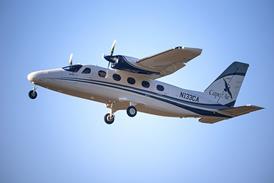














French investigators have disclosed that the nose-wheel of an Air Antilles De Havilland DHC-6 was not centred before the turboprop veered off the runway while landing and collided with a parked helicopter.
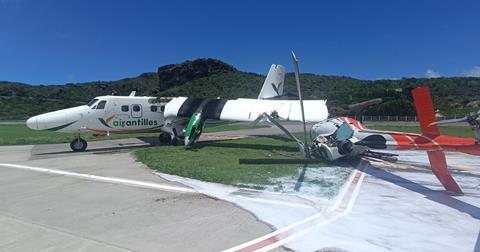
While none of the DHC-6’s eight occupants suffered serious injury in the accident at Saint-Barthelemy airport, the aircraft’s left wing was torn off and the helicopter – an Airbus Helicopters H125 – suffered sufficient damage to be considered economically unrepairable.
French investigation authority BEA found that operator CAIRE, which included Air Antilles, had not incorporated into DHC-6 manuals a 2017 checklist amendment intended to ensure the nose-wheel was both centred and locked after take-off and before landing.
This centring is achieved by aligning marks on the nose-wheel steering lever, located on the control column. But the amendment directs pilots to check the nose-wheel is locked in this position by applying a slight upward and downward pressure to the lever.
“The [nose-wheel steering] check after take-off and before landing was therefore not carried out, with the crew not making a manual input on the [steering] lever,” says BEA, in its findings into the 24 August 2023 accident.
Examination of the nose-wheel steering control cable revealed that the tension was insufficient, although the reason for the incorrect adjustment could not be determined.
As a result, the nose-wheel was probably not centred even though the steering lever marks were aligned, and neither was the nose-wheel locked.
“The nose-wheel probably pivoted during the flight,” says the inquiry.
BEA notes that cockpit-voice recorder information showed that the pilots did not observe the ‘sterile cockpit’ rule – nearly 60% of the time 8min 46s spent below 5,000ft during the approach was “devoted to conversation unrelated to the flight”.
“Moments of silence were nearly non-existent,” it says, and points out that the crew forgot to inhibit terrain alerts as the aircraft descended towards Saint-Barthelemy’s runway 28.
When the aircraft touched down it veered to the left. The captain, who was flying, took several actions in a bid to correct the course, including braking, steering and applying reverse thrust.
But he could not stop the DHC-6 from veering off the left side of the runway, crossing a grass shoulder and hitting a taxiway sign before striking the helicopter with its left wing. The aircraft (F-OMYS) pivoted before coming to a halt, and was subsequently evacuated.