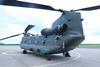
















The UK has performed a first test flight of a Boeing CH-47 Chinook transport helicopter equipped with a new infrared suppression system installed to boost the platform’s survivability.

“By reducing its infrared signature, the system significantly mitigates the threat posed by heat-seeking missiles, which are a common danger in operational theatres,” the UK’s Defence Equipment & Support organisation says.

“This capability is vital for ensuring the safety of personnel and the success of missions,” it adds.

RAF Chinook infrared suppressor

Source: Defence Equipment & Support

New infrared suppressor update has been flown on a UK Chinook for the first time

In another notable recent development, a Royal Air Force (RAF) Chinook was used to assess the viability of employing first person view (FPV) quadcopter drones launched from and controlled by an operator aboard the moving rotorcraft.

Boeing describes such a capability – trialled during an activity named ‘Hornets Nest’ – as enabling the Chinook to operate as a “mobile uncrewed systems carrier”.

FPV drone launch from Chinook

Source: Crown Copyright

‘Hornets Nest’ trial saw FPV drones launched from the rear ramp of a Royal Air Force Chinook

“By pairing the helicopter’s mobility with FPV drone capabilities, the RAF could soon enable airborne swarming to overwhelm enemy defences, disrupt communications or relay real-time intelligence,” the company suggests.

Meanwhile, the US airframer is seeing solid demand for its latest CH-47F Block II version of the Chinook, according to Mark Ballew, senior director, vertical lift business development.

Six examples have been delivered to the US government so far, and he says: “If you look at the budget cycles for 2026 there are dollars for the procurement of the next lot of aircraft, plus long-lead [funding] for 2027.

“We are confident that Block II will go forward and we will be building the aircraft well through the 2030s,” Ballew told reporters at the Royal International Air Tattoo in the UK on 19 July. In addition to planned production for the US Army, he notes: “It is typical that the countries that fly the Chinook will come back and get the latest model.”

Germany, meanwhile, “will be on contract for their 60 aircraft later this year”, with deliveries to begin in 2027, he says.

And Poland – which is to field a 96-strong fleet of Boeing AH-64E Apache attack helicopters – has identified a requirement for a heavy-lift type to support those assets. Speaking earlier this year, defence minister Wladyslaw Kosiniak-Kamysz indicated that the CH-47F is the only viable candidate for such a requirement.

“They have had conversations with us about why it is important to have Chinook being interoperable with the Apache,” Ballew says.

Warsaw’s order for the Apache is also drawing close to final confirmation, meanwhile. “We are in the process of putting that request for proposal [response] together now for the US government, and are projected to be on contract later this year,” Ballew says.

The Polish army recently took delivery of four D-model examples being leased from the USA, with those aircraft to help with its preparations for fielding the Apache operationally.