







US aircraft manufacturer Textron has revealed the aircraft it intends to compete to be the US Navy’s (USN’s) new trainer jet.
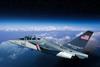
Textron on 28 July said it has entered a teaming agreement with Leonardo to bid for the navy’s Undergraduate Jet Training System (UJTS) programme with a version of Leonardo’s M-346 dubbed the Beechcraft M-346N.
Beechcraft is a brand of Textron Aviation.
“The Beechcraft M-346N is part of a proven integrated training system based on the original M-346 aircraft developed by Leonardo,” Textron says.
The development is not unexpected, as the pair in 2024 declared their intent to partner on an M-346-based offer for UJTS. Although Leonardo will provide the aircraft, Textron has previously said the jets will be assembled in the USA.
“With our heritage deeply rooted in the strength and reliability of American manufacturing, the Beechcraft M-346N joins a proud line-up of aircraft built on 95 years of aviation excellence,” says Travis Tyler, chief executive of Textron Aviation Defense.

More than 100 of Leonardo’s standard M-346 jets are already in service globally as trainers, according to Textron. The fleet includes 21 aircraft operated by the International Flight Training School operated by the Italian air force, Leonardo and Canada’s CAE.
Much like its originator, the new M-346N will be a twin-engined, tandem-seat jet equipped with an all-digital fly-by-wire flight control system and an Automatic Ground Collision Avoidance System (Auto-GCAS).
Two Honeywell F124-GA-200 turbofans will power the M-346N, which Textron says will boast maximum cruising speed of more than 590kt (1,092km/h) and a service ceiling of 45,000ft.
“The result is a trainer that effectively bridges basic instruction and the high-performance world of carrier-based fighter operations,” Textron says.
The M-346N is expected to compete for the UJTS contract against Boeing’s T-7A Red Hawk and Lockheed Martin’s TF-50, a derivative of Korea Aerospace Industries’ T-50 trainer. The effort aims to replace the service’s aged fleet of 189 Boeing T-45C Goshawks.

The navy in March said the new trainer need not be capable of landing on the service’s fleet of aircraft carriers, meaning none of the potential competitors would need to be modified with the strengthened landing gear and tail hook necessary for carrier recovery and launch.
“Due to advancements in operational platform landing modes and in ground-based simulation, the UJTS air vehicle will only be required to conduct field carrier landing practice to wave off,” the USN said in a request for information (RFI) released in March.
The UJTS effort was launched in May 2020. Five years later, the USN has yet to issue formal requirements and officially start the procurement process.
The service has released numerous information gathering solicitations to industry in the interim. Most recently, the navy on 12 June issued an update to the March RFI, which was itself the fifth such notice.
Those documents indicate the UJTS aircraft will be used to train a range of basic and advanced tactical flight competencies, including basic familiarisation, formation flying, low-level navigation, fighter intercepts, basic air-to-air combat manoeuvres and air-to-ground weapon delivery.
The navy said in April it plans to issue a formal UJTS request for proposals (RFP) in December this year, kicking off the procurement process. Current schedules call for a winner to be selected in January 2027.
The RFP will cover the initial engineering, manufacturing and development phase of the UJTS contract, plus procurement of the first lot of low-rate initial production aircraft and limited quantities of ground-based training systems, according to the navy.
A minimum fleet requirement of 145 has previously been suggested.
An older RFI from 2024 listed some aircraft performance requirements under consideration, including a mission-capable rate of at least 80%, a minimum airframe life of 10,000h and 35,000 landings, and ability to carry 12 Mk76 training munitions.
The mission availability rate is particularly significant, as the navy says maintenance issues have plagued the T-45 fleet, driven by “significant aircraft, engine and component obsolescence issues”.
Those problems have significantly impacted the service’s ability to certificate new pilots.
The oldest T-45 has been in service for more than 36 years, according to data from aviation analytics firm Cirium.