














Losses on two international helicopter programmes generated significant financial drag at US defence manufacturer Lockheed Martin during the recent second quarter.
Via its vertical-lift subsidiary Sikorsky, Lockheed absorbed a total of $655 million in penalties between April and June on rotorcraft contracts for Canada and Turkey. Sikorsky’s operations are accounted for under Lockheed’s Rotary and Mission Systems business unit.
The Canadian Maritime Helicopter Programme (CMHP) made up the bulk of the loss, coming out $570 in the red during the quarter. Lockheed says that figure is based on revised cost and sales estimates following discussions with Ottawa about restructuring its CMHP contract to offer enhanced sustainment support and improved aircraft utilisation rates.
“We are focused on providing additional mission capabilities, enhancing logistical support, extending the fleet’s life, while we continue discussions to potentially restructure certain contract terms,” said Lockheed chief executive James Taiclet during a 22 July investor call.
Sikorsky was awarded the contract to replace Canada’s fleet of CH-124 Sea King helicopters – another Sikorsky type – in 2004, before the company was acquired by Lockheed.
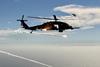
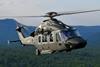
The result was the CH-148 Cyclone, a derivative of Sikorsky’s S-92 civil type.
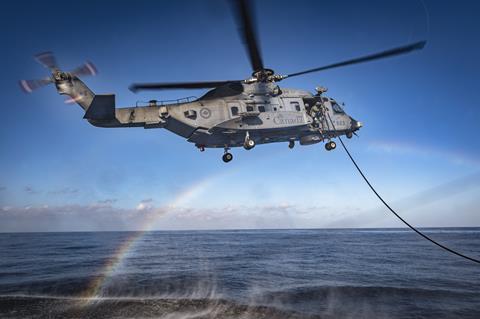
The Royal Canadian Air Force (RCAF) has 25 CH-148s in service and one example in storage, according to fleets data from aviation analytics firm Cirium. One Cyclone was lost in 2020, when the helicopter crashed off the coast of Greece, killing all six Canadian personnel aboard.
In 2023, families of the deceased RCAF crew sued Sikorsky in US court, alleging a flaw in the Cyclone’s fly-by-wire flight control system overrode the pilot’s inputs and caused the crash.
Sikorsky reached a settlement agreement with the plaintiffs in late June for an undisclosed sum. It is unclear if the settlement payment factored into the recent losses recorded on the CMHP activity.
The CH-148 fleet has faced engineering challenges in recent years, including the 2021 discovery of cracks in the tail sections of 19 Cyclones. That issue was found to be unique to the RCAF rotorcraft and not detected among the broader S-92 family.
Across the Atlantic, Sikorsky also shouldered $95 million in losses on the Turkish Utility Helicopter Programme (TUHP) to provide Turkey with S-70 Black Hawk rotorcraft.
In 2014, Ankara signed a deal with Sikorsky for 109 examples of the utility helicopter, which was selected as the winner of the TUHP contract in 2011.
The rotorcraft was locally designated the T-70 and assembled locally by Turkish Aerospace. At least 90 examples are currently in service across the Turkish army, navy, and air force, Cirium suggests.
However, that programme has apparently fallen victim to the economic sanctions levelled against Turkey by the US government following Ankara’s 2019 decision to purchase a Russian S-400 air defence system.
Among the entities targeted in those 2020 sanctions are the Turkish government’s Defense Industry Agency, formerly known as the Presidency of Defense Industries.
“US government sanctions on Turkish entities and persons have affected the company’s ability to perform under this programme,” says Lockheed chief financial officer Evan Scott.
“We’ve been communicating with the prime contract customer regarding alternative paths, and during the second quarter, the company recognised a $95 million loss reflecting the latest status of those discussions,” he adds.
Other consequences of the S-400 decision have included Washington barring Turkey from the multi-national F-35 stealth fighter programme, another Lockheed product.
The impact of the sanctions was previously flagged in Lockheed’s 2024 annual report, released earlier this year.
In that filing, Lockheed revealed it has struggled to obtain the necessary export licenses and authorisations required to fulfill its existing contractual obligations under the TUHP deal.
The issue is severe enough that Lockheed issued a force majeure notice under the impacted contracts and partially stopped work on the programme in October. The company also hinted at the possibility of future losses on TUHP, which have now come to fruition.
“Our customer and subcontractor have asserted that we do not have the contractual right to stop work,” Lockheed noted.
The defence manufacturer further warned that such actions taken by the US government could hinder future efforts to compete for overseas business and “may in the future result in our inability to recover our costs”.
In the recent second quarter earnings call, Lockheed CEO Taiclet declared both the Turkish and Canadian rotorcraft programmes will be subject to a new and robust company oversight regime that will include regular review by senior management.