

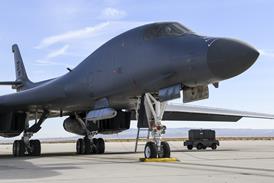














While the commercial aviation sector has been investing heavily in sustainability, the interest from military operators has been far more tepid.
Although the US Air Force has provided research and development funding to a number of electric and hybrid-electric aircraft designers, including Beta Technologies and Electra, the Pentagon has no plans to field sustainable aircraft operationally.
The prospects for such a move have become even dimmer under the Trump Administration, which has purged support for electric vehicles, climate change research, renewable energy, and defence programmes not focused on the ill-defined concept of “lethality”.
However, one major defence manufacturer sees such technology as an important plank of its future business.
“We think hybrid-electric will be a big part of the future,” says Rich Benton, general manager of vertical lift heavyweight Sikorsky.
Speaking to FlightGlobal, Benton says hybrid-electric propulsion systems have the potential to increase the range of conventional helicopters by 30%, along with similar reductions in operating and maintenance costs.
Instead of transferring mechanical energy from a turboshaft to rotor blades, a serial hybrid-electric propulsion system employs a small thermal engine as a turbogenerator, which then powers the electric proprotor motors.
“We only have electrical wiring instead of transmissions and drivetrains, so it has fewer failure points,” Ramsey Bentley, Sikorsky’s director of advanced concepts and innovation, tells FlightGlobal.
This, he notes, also makes hybrid-electric rotorcraft easier and cheaper to maintain, even in an austere field environment.
Benton also notes that the hybrid-electric propulsion systems under development could also be capable of operating in a full-electric mode, offering unique benefits to rotorcraft operators.
“Now you don’t have an engine or a turbine running,” Benton notes. “That provides a unique acoustic signature, depending on what the mission capability would be.”
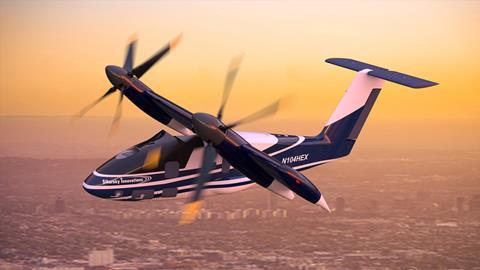
Sikorsky is developing a prototype hybrid-electric vertical take-off and landing (VTOL) demonstrator known as HEX that will boast a range of some 500nm (926km) with maximum gross take-off weight of 4,800kg (9,000lb) and the ability to travel at “high speed”.
The tiltwing concept is powered by two GE Aerospace 600kW electric motors, coupled with a 1.2MW generator, and equipped with Sikorsky’s proprietary Matrix autonomous flight system.
Although its initial HEX concept will be controlled by an onboard pilot and be capable of carrying passengers, the design is meant to serve as a platform to demonstrate and mature technology for a future family of air mobility vehicles.
Elsewhere, Sikorsky is advancing another hybrid-electric tiltwing vehicle intended for operational military service.
Known as the rotor-blown-wing (RBW), the uncrewed VTOL rotorcraft will come in a range of sizes intended for different mission sets, including reconnaissance, air-to-ground strike, electronic warfare or even transporting cargo.
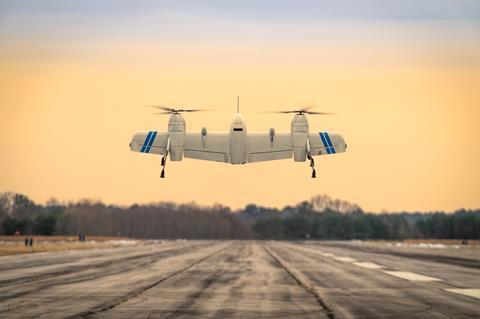
In January, the company completed a successful transition from vertical to forward flight using a 3.1m (10.3ft) wingspan, 52kg sub-scale RBW demonstrator – a task which required developing new control laws for the novel aircraft.
Sikorsky has since completed dozens of flights with the tail-sitting vehicle, with strong optimism about potential military applications for the hybrid-electric concept.
The company envisions at least four different autonomous RBW variants, with two in the Group 4 category of large uncrewed aircraft with a maximum take-off weight above 598kg and an operating ceiling of up to 18,000ft.
Benton says the largest RBW models could be outfitted with an underwing cabin to carry passengers, opening up a wider range of commercial and military applications.
Notably, he says the best opportunity to launch the new hybrid-electric engine technology may be in the civil market, which has not been a major business focus for Sikorsky in recent years.
“We’re looking at potentially the civil market being the launch customer for hybrid-electric,” he notes.
This could see a new aircraft reach the market in the 2030s. Benton says it could be either a tiltwing or a conventional single-main rotor design.