















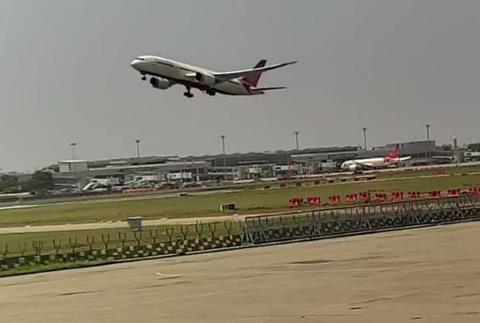
While the Air India Boeing 787-8 crash inquiry has found that fuel control cut-off switches were activated almost as soon as the aircraft lifted off, the circumstances of the switches’ movement remain unexplained.
Preliminary findings from India’s Aircraft Accident Investigation Bureau simply state that both switches “transitioned” to the ‘cut-off’ position, within 1s of one another – without indicating whether they were moved inadvertently, or deliberately, by the crew or whether some other object or force interfered.
Investigators point to the aircraft reaching 180kt about 3s after lift-off, and the switch transition taking place “immediately thereafter”, meaning the aircraft experienced barely three or four seconds of powered flight as it attempted to climb away from Ahmedabad’s runway 23 on 12 June.
The fuel cut-off toggle switches are located behind the thrust levers, which would have been advanced for the take-off and initial climb, and ahead of the engine-fire extinguisher discharge handles.
Neither pilot, during a routine take-off, would normally reach behind the thrust levers just after lift-off. The crew would typically confirm positive climb and, about 10s after rotation, raise the landing-gear lever on the forward instrument panel.
The 787 has stabiliser cut-out switches, and alternate pitch-trim switches, immediately to the left of the fuel cut-off switches. Nose-up trim is commanded by pushing the switches downwards. Pitch trim is normally controlled, however, by a switch on the pilot’s control column.
Investigators noted that when the aircraft arrived at Ahmedabad, a stabiliser position transducer defect had been recorded. The inquiry says fault troubleshooting was carried out and the aircraft was released for the service to London Gatwick. It has not indicated whether this bears any relevance.
The preliminary findings state that the aircraft, its ram-air turbine deployed, began losing height even before it cleared the airport’s perimeter wall.
Investigators have not confirmed how long the fuel switches had been in the cut-off position before the crew noticed. The inquiry only mentions, without a direct transcript of the exchange, that one pilot queried the other as to why they were off, to which the other pilot responded that he had not turned them off.
But less than 10s after the switches moved to ‘cut-off’ the left engine’s was moved back to the ‘run’ position, followed by the right engine’s 4s later. This initiated an automatic relight, but while successful the process could not restore sufficient thrust in time to arrest the 787’s descent.
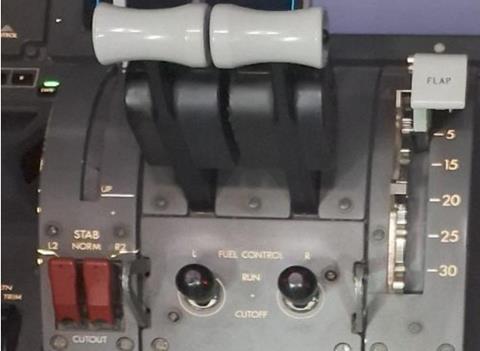
Examination of the wreckage found the aircraft’s flap handle at the normal 5° take-off setting, and the landing-gear lever still down. Although both thrust levers were near the idle position, flight-recorder data shows both remained forward, at the take-off thrust setting, until impact. Both fuel control switches were in the ‘run’ position.
While the reason for the initial movement of the fuel switches has not been identified, the inquiry mentions a safety advisory from the US FAA which states that the Honeywell switches are fitted to eight Boeing models – including all three variants of the 787 – but that some might have a locking system disengaged, based on reports from a number of 737 operators.
“In order to move the switch from one position to the other under the condition where the locking feature is engaged, it is necessary for the pilot to lift the switch up while transitioning the switch position,” says the special airworthiness bulletin of December 2018.
“If the locking feature is disengaged, the switch can be moved between the two positions without lifting the switch during transition, and the switch would be exposed to the potential of inadvertent operation.”
Such an error could result in the switch being moved to the ‘cut-off’ position, with the risk of in-flight engine shutdown, it points out. It recommends – although does not mandate – a ground inspection of the locking mechanism to “ensure its engagement”, by checking whether the switch can be moved between the two positions without lifting.
“If the switch can be moved without lifting it up, the locking feature has been disengaged and the switch should be replaced at the earliest opportunity,” the bulletin adds.
Both pilots were experienced on the 787. The captain had nearly 8,600h on the type, and the first officer, who was flying, had over 1,100h.
Investigators have confirmed that, of the 242 occupants, a single passenger survived the accident, which also resulted in 19 fatalities on the ground.