












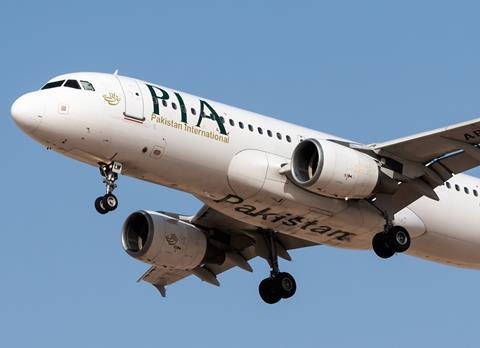
Investigators have determined that the first officer of a Pakistan International Airlines Airbus A320 selected the wrong ILS frequency before a wrong-runway landing at Lahore.
The twinjet had been operating flight PK150 from Dammam, in Saudi Arabia, to Multan on 17 January.
But Pakistani investigation authority BASIP, in findings released on 4 November, says adverse weather at Multan, with visibility down to 50m, prompted the crew to divert.
Although the initial diversion airport was Karachi – where visibility was good – the crew instead opted for Lahore, after considering such factors as passenger convenience and cabin crew duty time.
Low-visibility procedures were in place at Lahore owing to fog.
BASIP points out that selecting an alternate airport with tougher landing conditions is “contrary to safe recommended procedures” if there is no technical problem with the aircraft.
The captain, who was flying, referred to the diversion route several times, mentioning Lahore’s runway 36R and the ILS Z approach, says the inquiry.
But when setting the Lahore approach on the flight-management system, the first officer selected ILS 36L Z on the first display page of arrival options, rather than ILS 36R Z which appeared on the second page.
The two had different ILS frequencies, respectively 109.7MHz and 109.9MHz, but the inquiry points out that the captain, despite communicating the correct runway, mentioned the wrong 109.7MHz frequency – possibly because he had carried out several landings on Karachi’s runway 25L, which has the same frequency.
It says both pilots “failed to cross-check” the ILS frequencies during descent and approach to Lahore, and they “could not identify” the error through various cues on the flight-management system or cockpit displays.
“Despite correctly communicating the intended runway with [air traffic control] and among themselves, they failed to maintain awareness of their cockpit setting and the correct runway environment,” it adds.
Investigators state that the first officer’s feeding of data into the flight-management system was a “clear violation” of procedure, because this should have been the captain’s task, with the first officer checking.
The captain had to correct a missed-approach height which was “wrongly fed” from the first officer as 1,700ft, the inquiry says. It also notes that the pilots took “considerable time” to revise low-visibility procedures, adding that the first officer, who had 160h on type, appeared to have “poor knowledge” and needed support from the captain.
Lahore tower cleared the aircraft to land on runway 36R at a distance of 5.6nm, but the tower controller – despite not having visual contact – failed to monitor the flight on radar, until an approach controller informed that the jet, at 1.7nm, was left of track.
Instead of ordering a go-around, or advising the crew, the tower controller turned on the 36L approach lights – a decision which could have had consequences during the landing roll, the inquiry says.
“Despite [the aircraft’s] misalignment, both [tower and approach controllers were] hesitant to [order a go-around] due to fear of punitive actions from their supervisors, reflecting a toxic safety culture,” it adds.
While the aircraft landed safely on 36L, with no injuries among the 182 occupants, the investigation concludes that both pilots demonstrated poor situational awareness and task-sharing procedures, indicating a breakdown in crew resource management.