
















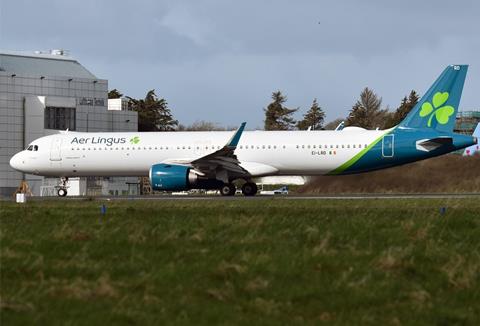
Irish investigators believe a sudden pitch-up input during a bounced landing resulted in an Aer Lingus Airbus A321LR’s sustaining a tail-strike on touchdown at Washington Dulles two years ago.
The aircraft, arriving from Dublin on 30 August 2023, had been descending to runway 01R in gusting wind conditions and deviated from the glideslope at 300ft, becoming slightly high.
Ireland’s Air Accident Investigation Unit says the first officer, who was flying manually, responded with a nose-down input at 120ft which coincided with a loss of headwind.
This caused the aircraft to descend more rapidly, reaching 976ft/min. After a caution from the captain to watch the pitch attitude, the first officer initiated the flare with a “rapid” aft sidestick movement that reduced the descent rate to 150ft/min.
As the jet touched down – with a nose-up pitch of 7.5° and a 1.6g impact – only one of the three spoiler elevator computers validated both main landing-gear as being on the ground.
This meant there was no automatic compensation command to the elevators to counter the characteristic pitch-up caused when the spoilers deployed on the wings.
The aircraft bounced to a height of 3ft, says the inquiry, and the first officer made an “intuitive” pitch-up input on the sidestick – either due to being startled by the bounce, or in a bid to smooth the second touchdown.
This nose-up input increased the pitch to 10.1°, exceeding the tail-strike threshold of 9.7°, and the aircraft’s aft fuselage contacted the runway when it touched down for the second time.
The captain simultaneously took control of the jet and initiated a go-around, following which the A321LR landed on the same runway without further incident.
Airbus’s crew training manual states that, if the aircraft experiences a high sink-rate near the ground, a pilot might attempt to avoid a hard landing with high nose-up pitch commands – which could result in control difficulties after touchdown. The inquiry says the Dulles occurrence illustrated this scenario.
Although the jet (EI-LRD) sustained aft fuselage damage, and two cabin crew reported minor injuries, none of the 151 occupants was seriously injured.
Aer Lingus took steps to enhance simulator training for go-arounds near the ground, as well as tail-strike awareness, says the inquiry, adding that Airbus intends to improve system logic for spoiler compensation around mid-2028.