









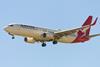

Australian investigators have determined that a Qantas Boeing 737-800 departed Canberra with incorrect take-off performance data, after more than 50 passengers were erroneously listed as no longer on board.
While the airline’s load-control personnel were suspicious about the data while compiling the aircraft’s loadsheet, it was nevertheless handed to the 737’s crew “without resolution”, says the Australian Transport Safety Bureau.
It adds that, although the error was subsequently identified, communication procedures were not followed and the crew was not informed before the aircraft departed.
“This occurrence highlights the importance of pro-actively identifying, addressing, and, when necessary, escalating unusual situations,” says the safety bureau. “It is not sufficient to rely on downstream controls or other functions to intervene or trap errors.”
The inquiry into the event states that the 737 had arrived at Canberra – with six crew members and 172 passengers – on 1 December last year, having been diverted from Sydney owing to weather conditions.
Seventeen passengers, who had been heading for Canberra, were allowed to disembark, leaving 155 on board.

The carrier’s departure control system needed to be updated in order for the aircraft to proceed to Sydney. This was achieved by creating a new flight, designated an ‘addstop’, for the Canberra-Sydney sector.
But the aircraft type code for the addstop was inadvertently entered incorrectly; the code for a Boeing 717, which had 125 seats, was used instead of that for the 176-seat Boeing 737.
This difference of 51 seats meant the system automatically offloaded all 11 business-class passengers and placed at least 40 economy passengers on standby.
Although the individual carrying out the update “almost immediately” recognised the aircraft code error after committing to the change and, after locating a systems manager to unlock the flight, corrected the code. But the system’s offloading of passengers went unnoticed.
Once the flight became available to the Qantas airport duty manager in the customer management system, it was adjusted to account for the 17 disembarking passengers.
The remaining passengers were mass-boarded by the duty manager in a single transaction, and the flight closed, but a customer service agent subsequently queried the system’s listing of 51 offloaded and standby passengers – an unusual scenario for a diverted flight.
Attempts to onboard the passengers within the system were unsuccessful, but the duty manager did not contact the load control leader, believing they would “already be aware of the issue” and would rectify the situation before issuing the loadsheet.
But although the load controller was aware of a significant discrepancy between the inbound flight and the addstop flight to Sydney, they had difficulties trying to understand it. They were advised to use the passenger figure in the system, because it had been confirmed by Qantas airport personnel, and issued a loadsheet to the aircraft crew “despite having ongoing concerns about the validity of the information”, says the inquiry.
The error was detected a short time later, but attempts to contact the aircraft captain – through various channels, including mobile phone – were unsuccessful, partly because the crew turned off company radio frequencies in order to calculate take-off performance undistracted.
“On receipt of the final loadsheet, the captain believed the reduced passenger figure reflected the number of people that had left the aircraft,” says the inquiry. “Other than the passenger figure within the loadsheet, the flight crew were not advised of the final number of passengers that had disembarked the aircraft, nor was there a procedural requirement to do so.”
As a result the performance calculation was based on a weight that was 4.29t lower than the actual figure. The captain recalled that the jet was “slightly slow” to accelerate, but the crew experienced no control difficulties.
Once in cruise at 15,000ft the crew was advised via the ACARS communications system that the loadsheet was incorrect. The aircraft entered a holding pattern while the correct weights were established, but then proceeded to Sydney without further incident.
Qantas has since introduced a requirement for a passenger headcount if a discrepancy is identified, while procedures for communicating critical flight information have been amended.