














An airship hovers at 1,200ft over the suburbs while small, unmanned aircraft shuttle to and from the cargo deck dispatching individual parcels to homes. That is the “airborne distribution centre” vision of developer Igor Pasternak, who insists a concept he has spent more than a decade talking up is close to reality.
His company, Los Angeles-based airship manufacturer Aeros, plans a trial later this year using one of the company’s in-production blimps. He hopes the publicity will kickstart a fund-raising effort that will eventually lead to a family of what he terms electrically powered variable buoyancy airships, or eVBAs.
Pasternak, who founded Aeros in 1995, says his Aeroscraft airships will be able to rise and descend vertically and remain in a stable hover for long periods, thanks to a patented system that compresses and releases helium within the hull, removing the need for ballast when cargo is removed.
He hopes to conduct the trial above greater Los Angeles before the end of the year. While the Sky Dragon airship it will use in the demonstration is essentially a 900kg (1,980lb)-payload surveillance platform, it can carry enough parcels to prove the concept, according to Pasternak.
Pasternak, who is partnering with a supplier of parcel-carrying drones and fulfillment specialist Shipbots, says the next step will be to establish an Aeroscraft production line. “First, we want to prove the commercial business model. Then it is about scaling,” says the Ukrainian-raised entrepreneur.
That scale-up will involve the certification of, initially, the 10t-capacity Aeroscraft ML806 – an 80m (262ft)-long airship with a 432nm (800km) range and 6,000ft operating ceiling. Pasternak’s goal is to raise enough finance to establish an assembly line in California or Nevada and have three ML806s in production by 2027.
Beyond that, he hopes an initial public offering (IPO) later in the decade will generate the finance to bring to market two larger eVBAs – the 66t-payload ML866 and the 244t-payload ML888. The latter’s 5,390nm range, he says, would allow the launch of long-range, even intercontinental, heavy cargo operations.
In May, Aeros completed the construction of the iron bird of the Aeroscraft’s cargo bay, which it says will validate the cargo handling systems of its new airships. He says the aircraft will typically have a crew of five – two pilots, a drone pilot, a loadmaster and a supervisor – although some of these roles could be duplicated.
Pasternak says the Aeroscraft differs from the blimps and aerostats that Aeros has been building for 30 years in that it uses a process like a submarine’s ballast system to descend, by compressing the helium into internal “pressurisation envelopes” and filling the vacuum with heavier atmospheric air. The compressed helium is released back into the hull’s tanks, forcing out the air to create lift.
He maintains the ability to hover is the “holy grail” making it ideal for the cargo mission. “This type of airship must be able to pick up and drop parcels without landing. Its buoyancy control keeps it stable and means it does not need to touch the ground, so can operate anywhere,” he says.
He believes that a burgeoning logistics market, including e-commerce, is constrained by infrastructure – roads, ports, railways, and airports – that is often at capacity and in the “wrong” place. Creating airborne delivery hubs that can be flown close to the “last mile” solves many of these problems, he maintains.
One challenge remains the ability of cargo drones to fly above 400ft, their current limit under Federal Aviation Administration rules. The Aeroscraft’s optimal hovering altitude is 1,200ft. However, Pasternak says the FAA – which in early September pitched a new regulatory framework for expanded beyond-sight drone operations – is enthusiastic about the concept and is “on board”.
As part of its funding drive, Aeros plans to raise an undisclosed amount through a “Regulation A” offering which allows a US company to sell securities up to $75 million without a full IPO. Earlier this year, it signed a memorandum of understanding with a “major global institutional investor”, the terms of which were confidential.
Pasternak and the business have their roots in Ukraine, following the late-1980s perestroika reforms of Soviet leader Mikhail Gorbachev, which allowed the first private companies to emerge. After producing a series of tethered balloons for advertising, Pasternak moved to the USA in the 1990s and established the company in California.
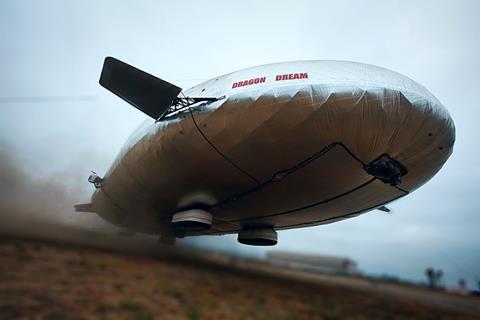
Aeros has since produced about 25 certificated airships and supplied tethered aerostats to the US military that were deployed during the Iraq and Afghanistan campaigns. A $60 million grant from the Defense Advanced Research Projects Agency under its Project Pelican effort led to Aeros developing and flying in September 2013 a half-scale demonstrator of the Aeroscraft dubbed the Dragon Dream.
Pasternak says that after 30 years of building and selling airships, for the flying warehouse concept to gain momentum, Aeros itself will have to operate it. “It will be the first time I will have owned an airship,” he says. “But in this situation the OEM must be an operator.”
He believes the market for flying warehouses and cargo airships generally could be huge but admits that after years of small-scale production of less sophisticated airships and aerostats, the step up to Aeroscraft could be challenging. “The challenge is industrialisation,” he says. “For this to work, we must build fast, for the right price and at a large scale.”