














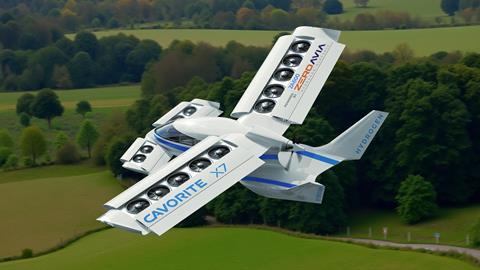
Canada’s Horizon Aircraft insists a newly disclosed collaboration agreement with hydrogen propulsion developer ZeroAvia does not change a go-to-market strategy for its Cavorite X7 that is based on hybrid-electric power.
In fact, says Horizon chief executive Brandon Robinson, hydrogen propulsion may never form part of its development roadmap for the X7 but the ZeroAvia pact will at least allow it to better understand the fuel’s “future potential”.
He praises ZeroAvia’s “hardcore engineering” approach and the technical progress made on the firm’s 600kW ZA600 fuel cell powertrain and associated electrical propulsion unit.
“We take them seriously; they are convincing from an engineering perspective. It’s a good place to start for us to look at a bunch of different things, including hydrogen power eventually,” he told FlightGlobal on 15 July.
Although initial CAD studies have shown the X7 – a six-passenger vertical take-off and landing (VTOL) design – could accommodate the powertrain, there are multiple other technical and operational hurdles to overcome before it could be considered for use in the aircraft, Robinson says.
These include the inevitable reduction in passenger or cargo capacity due to the size of the hydrogen storage tanks, likely higher weight and drag from the system’s heat exchangers, as well as the cost and availability challenges of the fuel itself.
The latter is a particular consideration for likely operators of the X7 who, based on Horizon’s market research “will be flying to unsupported locations”.
One of the advantages touted for a hydrogen powertrain is the longer range achievable compared with a pure-electric architecture, but given Horizon’s hybrid-electric configuration it is unclear if that would be the case with the X7.
“I don’t think range would increase that much,” says Robinson, but notes that parameter depends on multiple other factors such as the size of the fuel tanks and payload.
“The point is for us to take a look into it and make sure that is a correct statement. I want to get into the details, and I want to understand fuel burn, voltages, heat exchange problems, additional parasitic drag,” he says.
“Maybe the range does meaningfully increase and I’ve got it wrong. We are doing some investigative engineering to see where the corners of the box are in a sufficiently detailed manner.”
Robinson sees the work with ZeroAvia lasting for “at least 12 to 18 months” but says Horizon will not dedicate “a humongous amount of engineering resources” to the project to avoid becoming “distracted from our main focus” – developing and certificating the X7.
Horizon expects to achieve certification for the baseline Cavorite towards the end of the decade and to have “aircraft rolling off the production line” prior to 2030, he says.
ZeroAvia maintains the ZA600 powertrain will be certificated, initially by the UK Civil Aviation Authority, in late 2026 or early 2027, with service entry via conversion of a Cessna Caravan to follow that year.
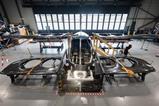
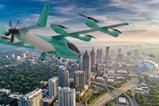
The Cavorite’s architecture uses battery-powered electric lift fans in the wings and canards, while a rear-mounted pusher propeller is driven by a thermal engine for forward flight, also recharging the batteries.
Although ZeroAvia’s commercial focus is on the integrated fuel cell powertrain, Robinson notes that the company also has some knowledge of hydrogen combustion, opening up another potential avenue for Horizon.
“But they’re a group of really savvy engineers that have been working with electric motors and power controllers and hybrid drivetrains in general, which is quite attractive to us,” he adds.
In the meantime, however, development of the hybrid-electric X7 continues at pace, building on flights with a scaled demonstrator that concluded earlier this year.
Ground tests of the first prototype will take place in late 2026, leading to a maiden sortie early the following year.
But that flight-test vehicle will initially be configured only for conventional take-off and landing operations, requiring a short lay up in 2027 for the installation of the lift fans.
Despite this, Robinson is hopeful a maiden sortie of the complete aircraft in VTOL mode can take place later that year.