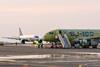













Metrea has taken the wraps off its Fireswift aerial firefighting platform, unveiling the freshly modified De Havilland Canada Dash 8-300 twin-turboprop at the Royal International Air Tattoo in the UK.
Better known for its fleet of aerial refuelling tankers, Metrea has been working on the Fireswift concept for the last three years, explains Steve Kemp, managing director and head of special aviation mission group.
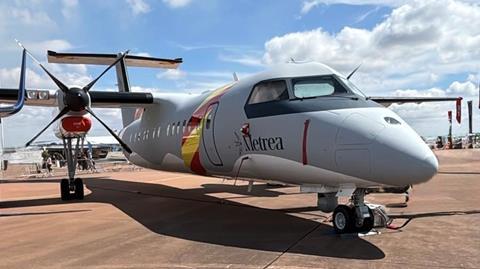
But rather than develop another platform that can simply drop retardant on a fire, Metrea has gone one step further, using its surveillance and communications expertise to significantly upgrade the aircraft’s capabilities.
So, although the Fireswift is equipped with a 6,000 litre (1,500USgal) tank and digital drop-control system, it also features a L3Harris Wescam MX-15 electro-optical turret and SpaceX Starlink connectivity.
It is these features that distinguish the aircraft, says Kemp, allowing it to function as a command and control platform as well as in the aerial firefighter role.
Data and imagery collected via the sensor suite can be relayed, through Metrea’s mission system, to all firefighting units, whether on the ground, in the air, or at a headquarters.
In addition, says Kemp, the sensors increase the accuracy of the retardant drops, enabling the Fireswift to take on the role of ‘bird dog’ or spotter aircraft commonly used to guide larger aircraft towards a fire.
Metrea picked the Dash 8-300 as the basis for the Fireswift as it is a “robust, proven platform”, with a strong feedstock pipeline as airlines begin to divest the type from their fleets.
“We have taken that rugged, proven aircraft and brought some high-end technology to it,” he says.
It also occupies the middle ground between smaller turboprop firefighters and bigger platforms like the Dash 8-400 or Boeing 737, he says, blending an ability to operate from short or austere airfields with high transit speed and long loiter time “without the cost and complexity of a larger aircraft”.
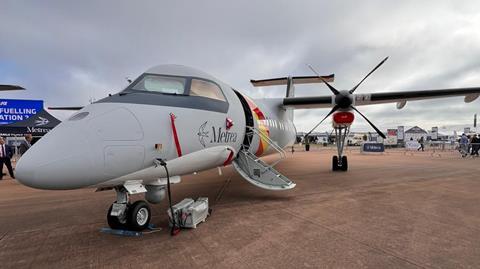
Like the rest of its fleet, Metrea will operate the Fireswift on customers’ behalf, through its “effects as a service” model, also known as ‘commercially-owned, commercially-operated’.
Talks are ongoing with potential customers in Europe, North America and Australia, he adds.
“We have developed this aircraft at our own risk – it has not been built under contract. We came up with what we think is the right product.”
Metrea is now around halfway through testing the Fireswift, having concluded an initial phase to evaluate the modified aircraft’s handling and surveillance equipment.
On its return to North America, a second step will see the turboprop conduct drop testing and validation from the US Interagency Airtanker Board, which evaluates aircraft against performance criteria and approves them for use.
A 1991-built example, the Fireswift (C-FADF) was previously operated by several Canadian regional carriers, and most recently owned by Jazz Aviation.
Metrea is in discussion with type certificate holder De Havilland Canada about “how we work together and how they could support this programme”, adds Kemp.