











Boeing expects to achieve certification of its 737 Max 7 and Max 10 in 2026 after completing an engine anti-ice system redesign that has taken longer than the company anticipated.

The manufacturing giant disclosed the timeline on 29 July when reporting its results for the second quarter, a period during which Boeing reached 737 Max and 787 production goals for 2024 while posting a $612 million loss.

Last quarter, Boeing brought 787 production to a seven-jets monthly rate, up from five monthly at the start of the year. It also boosted 737 output to 38 jets monthly, a milestone it had previously reported having hit.

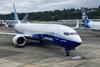
Boeing 737 Max 10 at Boeing Field in Seattle on 14 June 2022

Source: Jon Hemmerdinger, FlightGlobal

Boeing now says it expects to achieve certification of its Max 7 and Max 10 (above, at Boeing field) in 2026

Uncertainty has surrounded outstanding certifications of its 737 Max 7, the smallest variant of the narrowbody jet family, and its Max 10, the largest. In recent days, some US airline executives said they did not expect to receive their first of those types until 2026 or even 2027, suggesting more programme delays.

Both certification efforts are already years behind schedule, but in January last year Boeing revealed a new setback, saying it needed a year to redesign an engine anti-ice system for both the Max 7 and 10.

The existing engine anti-ice system can cause overheating in some circumstances. That system is found on the in-service 737 Max 8 and Max 9 – a concern the Federal Aviation Administration addressed temporarily by ordering airlines to instruct pilots not to use the system except when actually flying in ice or expecting to do so.

But discovery of the problem meant the Max 7 and 10 would not meet certification requirements, prompting Boeing to start redesigning the system.

While Boeing said it would have the fix complete within one year from January 2024, that period came and went, and Boeing had not recently provided any updated timeline.

But Boeing now says it aims to certify the Max 7 and 10 in 2026.

“We are continuing to mature the technical solution for engine anti-ice and the certification path for the [Max 7 and 10],” Boeing chief executive Kelly Ortberg said in a 29 July memo to employees. “Progress on this solution has taken longer than we expected, and we now anticipate that certification for the airplanes will take place next year.”

Ortberg also says in the memo that Boeing has achieved “more stability in our operations”.

“We are building momentum in our recovery and your hard work is evident in our second-quarter financial results reported today,” he adds.

Notably, Boeing delivered 150 aircraft in the second quarter, up from 92 deliveries in the same period last year.

The company’s focus now is “stabilising” 737 production at 38 monthly – a cap the FAA mandated following quality problems leading to the January 2024 in-flight failure of a 737 Max 9’s mid-cabin door plug.

Later this year, Boeing plans to ask the FAA for approval to ramp 737 output to rate 42, Ortberg says.

Boeing lost $612 million in the second quarter, much improved from its $1.4 billion loss in the same period of 2024. It generated $22.8 billion in second-quarter revenue, up 35% year on year.

The company’s commercial aircraft division posted a $557 million operating loss, improved from a $715 million operating loss in the prior-year period, with revenue up 81% year on year in the second quarter to $10.9 billion.

Boeing Global Services, the company’s aftermarket division, posted particularly strong second-quarter results, with a $1 billion operating profit, up 21% year on year.

Boeing Defense, Space & Security turned a $110 million operating profit, reversing a $913 million loss in the prior-year period.