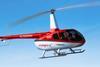
















Robinson Helicopter and electric propulsion specialist Magnix are jointly developing an all-electric variant of Robinson’s R66 helicopter, aiming to fly a demonstrator in late 2026.

The companies intend to prove the viability of a concept they view as competing in the emerging electric vertical take-off and landing (eVTOL) market.

But they say an electric R66 would be simpler and in some ways more practical than clean-sheet eVTOLs now under development by numerous start-ups.

“There are inherent advantages to low-disk loading that will be highly efficient for hovering flight, with fewer restrictions on the time you can hover,” Robinson chief executive David Smith said on 23 July.

Robinson and Magix

Source: Robinson Helicopter

Robinson and Magnix are aiming to get their all-electric R66 demonstrator airborne in late 2026

Disk loading is the ratio of an aircraft’s weight to rotor area; aircraft with a lower disk load require less power to hover.

The R66, with a single main two-bladed rotor, has one-fifth to one-sixth the disk loading of some in-development eVTOLs, Smith says. That means it requires less power to hover than multi-rotor eVTOLs, translating into better battery life.

“We think this is ultimately going to pay in cycle life and the cost of batteries,” he says.

Robinson has for several years evaluated propulsion alternatives for its R44, a four-seat helicopter with a single Lycoming IO-540 piston engine. Earlier in 2025, alongside biotechnology firm Unither Bioelectronics, it flight tested an R44 powered by a hydrogen fuel cell system, and in 2022 Unither flew an all-electric R44. Both aircraft used Magnix electric motors.

Robinson’s R66 is a five-seat aircraft powered by a single 270shp (201kW)-rated Rolls-Royce RR300 turbine.

At the Verticon helicopter expo in March, Washington state-based Magnix revealed its ’HeliStorm’ electric motors for rotary-wing aircraft. The powerplants will turn at 6,000-7,000rpm, compared with 1,900-2,500rpm for Magnix’s fixed-wing aircraft motors, and are targeted to replace small turboshafts like the RR300 and its M250 predecessor.

Robinson and Magnix say the modified R66 will be the first aircraft with a HeliStorm motor, which will be part of a Magnix-supplied 300kW/kg “fully integrated electric powertrain” that includes its Samson battery packs.

The project is already underway, with Magnix producing a “flight-worthy version” of the HeliStorm at its Washington site. Robinson will modify an R66 at its Torrance, California facility.

“In 2026, the electrification of the R66 will revolutionise the vertical take-off and landing market with its single-rotor simplicity and flight-proven capabilities,” the firms say.

“What we doing with this particular bird is building it up, so that we can show it to customers [and] get additional feedback about the commercial features that are needed,” says Smith. “We’ll use [the demonstrator] to basically build the spec for certification of a commercial version.”

Robinson aims for the demonstrator to use the R66’s standard gearbox and the same tail rotor architecture. 

“That’s one of the things we want to see from the testing - how the gear system performs,” says Smith, noting Robinson will closely evaluate how the electric powerplant’s high torque affects the gearbox.

david-smith-robinson-helicopter

Source: Robinson Helicopter

Robinson CEO David Smith expects the all-electric R66 will have flight endurance of about 1h, plus reserves

The HeliStorm engine will weigh “a lot less” than an RR300, says Smith without being more specific. Magnix previously said an initial 330kW HeliStorm variant would weigh 75kg (165lb); R-R’s website puts the RR300’s dry weight at 91kg.

The partners plan to evaluate various battery options, including batteries that can be removed and swapped out, which might appeal to customers running high-tempo operations. Roughly 1min of charging should equate to 1min of flight, Smith says.

He does not specify battery weight but says Robinson might increase the R66’s gross weight to allow for more battery capacity, and therefore more range, possibly at the expense of speed.

“That’s the kind of trade that I want to get customers’ feedback [on],” he says. “Our initial sweet spot is an hour of flight with reserves.”

Following test flights, Magnix and Robinson expect to progress toward achieving certification of the propulsion system and the aircraft. “It’s a long road to certification,” Smith says.

Many start-up eVTOL manufacturers such as Archer Aviation, Eve Air Mobility and Joby Aviation have pitched their designs as air taxis suited for operating short trips over major cities at low prices.

But Smith suspects such operations will be unfeasible, saying costs from landing fees, maintenance and insurance will make taxi-like flights prohibitively expensive for most people.

For that reason, he views electric R66s as suited to more traditional markets. The aircraft could be perfect, he says, for operating tour and sightseeing flights, which typically last only 15-30min. It could also excel as a trainer aircraft, and private buyers have shown interest, Smith says.