




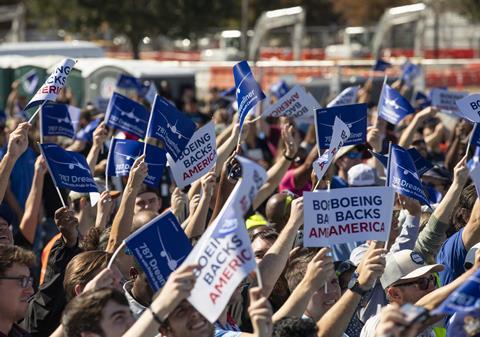
At an event in North Charleston last week, Boeing employees cheered and waved ’Boeing Backs America’ signs as the company revealed plans to open a second 787 assembly facility at Charleston International airport.
The expansion itself is big news, positioning Boeing to perhaps eventually double 787 production capacity.
But the event itself, with a pro-American theme, was also illustrative, demonstrating that Boeing views South Carolina as increasingly central to its future and highlighted the pivotal role the Trump administration has played in supporting the company’s future.
“You’ll notice a constant trend: where there is a Trump trade deal, there’s a Boeing sale,” US Treasury secretary Scott Bessent, a South Carolina native, told the hundreds-strong crowd gathered at Boeing’s 7 November groundbreaking event. “This administration backs Boeing because Boeing backs America.”
Boeing chief executive Kelly Ortberg last month presented President Donald Trump with the “salesman of the year award in the Oval Office”, Bessent adds.
The CEO has reason for thanks.
Pursuing his “America first” agenda, Trump has been a staunch Boeing supporter, urging countries to order jets as part of trade deals negotiated this year. Recent trade talks have coincided with Boeing securing orders or commitments from Bahrain, Indonesia, Japan, Malaysia, Qatar Airways, Saudi Arabia, South Korea, Thailand and Vietnam.
More recently, on 6 November, airlines from Kazakhstan, Tajikistan and Uzbekistan committed to ordering 787s.
“The president of Uzbekistan had placed a very large order for Boeing airplanes, and President Trump was urging him to buy more,” Bessent says.
Since Trump’s January inauguration, Boeing has landed orders for 321 787s, five times its 2024 orders. The company’s backlog includes 993 of the jets.
Boeing attributes the 787’s recent sales wins to more than Trump’s influence.
“The airplane does a very good job in service. Our customers know that it’s an efficiency leader…it beats the competition,” says Boeing’s 787 marketing director BJ Bryan.
The manufacturer has long planned to expand its South Carolina site, but on 7 November actually committed to doing so.
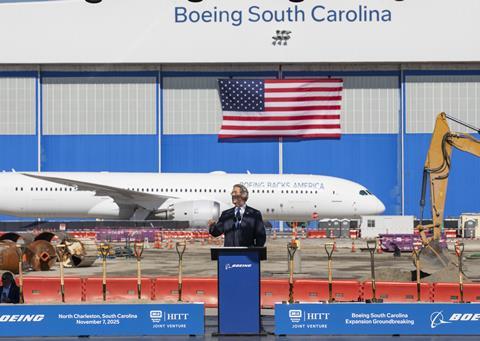
Its event that day kicked off with a rendition of the Star-Spangled Banner – the US national anthem. Many attendees were Boeing employees, including assembly site workers and executives like Boeing Commercial Airplanes CEO Stephanie Pope. State and local politicians, including South Carolina governor Henry McMaster, and representatives from construction firms were also on hand.
Behind a stage stood a 787 adorned with the ’Boeing Backs America’ tagline, and behind the jet towered Boeing’s existing 787 assembly site adorned with a massive American flag.
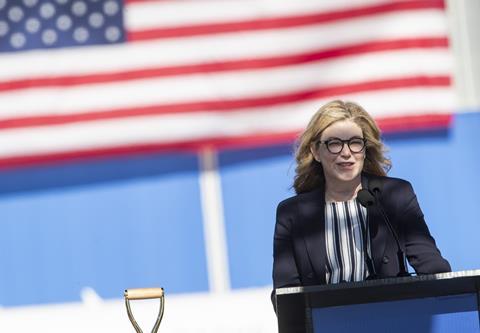
“We are preparing Boeing South Carolina for decades of 787 production,” Pope tells attendees. “One day your children, or maybe their children, will write the next chapter of Boeing’s story.”
Boeing now produces about seven 787s a month in North Charleston but aims to hit eight monthly before year-end and 10 monthly next year, executives have said.
It needs more assembly space to hike production beyond rate 10. Hence the expansion.
The project will see Boeing open a second 787 assembly facility adjacent to and roughly the same size as its current 111,500sq m (1.2 million sq ft) assembly building. The company expects the second site will be operating in 2028.
The project also involves opening a parts-preparation area facility, a vertical fin paint facility and flight-line stalls in North Charleston. Boeing says it will invest $1 billion on the project.
Boeing initially produced 787s only in Everett but in 2009 bought the North Charleston site from Vought Aircraft Industries. It then opened the 787 assembly site there.
Several years ago, as a cost-saving move amid the Covid-19 pandemic and weak demand, Boeing stopped producing 787s at the unionised Everett plant, leaving the non-unionised North Charleston site as its only 787 assembly facility.
Boeing’s North Charleston presence also includes a composite research centre, engine nacelle fabrication shop and an interiors production site. It also operates a fabrication shop in Orangeburg, South Carolina.