







Kazakhstan’s Air Astana Group has highlighted improvements in the Pratt & Whitney engines being delivered for its Airbus fleet, but believes remedy measures will still be needed over the course of this year and next.
The carrier has achieved its simplest fleet structure for more than two decades following the withdrawal of its last Embraer E2 regional aircraft.
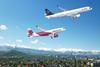
Air Astana Group has three Boeing 767-300ERs while the remainder of its 61-aircraft fleet comprises Airbus A320-family jets, six of which have been introduced over the first half of this year.
Thirty-four aircraft, including the 767s, are allocated to Air Astana with the other 27 assigned to its FlyArystan division.
The group says the conclusion of its reconfiguration to just two aircraft types leaves it with its simplest fleet profile since 2003, and enables it to unlock “operational efficiencies”.
It has also newly completed the modification of its A321LRs – covering six aircraft – which involves fitting auxiliary fuel tanks to extend their range and improve performance on routes from Almaty and Astana to destinations including Frankfurt, London, Tokyo, Phuket and Nha Trang.
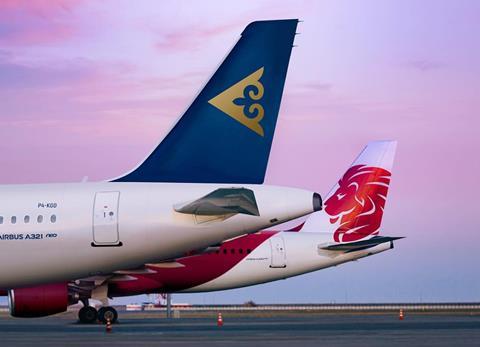
Air Astana Group says it is receiving “completely fault-free” Pratt & Whitney GTF engines for its A320neo-family fleet, but stresses that the assumed off-wing time for powerplants being remedied remains at 18 months.
“The remediation programme is expected to persist and require pro-active actions for at least 2025-26,” it states.
Its mitigation efforts include “resting” engines during the low season in order to deploy maximum capacity during the June-August peak.
“Beyond its primary sourcing channel being Pratt & Whitney, the group has effectively tapped into market supply for spare engines and remains committed to leveraging this strategy,” the company states, adding that it had obtained 13 spare powerplants for its A320neo family fleet by the end of June.
Chief executive Peter Foster says the company has invested in maintenance and ground-service capabilities, adding that this has enabled the group to demonstrate “resilience” in the face of the engine situation.
Air Astana Group turned in a first-half net profit of $10.7 million, more than double the previous figure, on a 12% rise in revenues to $658 million.
“Our performance highlights, once again, the benefits of our central location and agile approach as we successfully optimised costs and allocated capacity to our key markets to maximise margins,” says Foster.