















Shield AI has secured a contract to supply the Netherlands with eight V-Bat unmanned air systems for maritime surveillance duties.
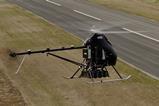
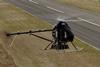
Announced in Den Helder on 9 July, the selection will lead to the delivery of the ducted-fan-engined, vertical take-off and landing (VTOL) aircraft for use during intelligence, surveillance and reconnaissance (ISR) operations by the Royal Netherlands Navy and Marine Corps.
“V-Bat’s small logistical footprint, ease of use and the possibility to deploy from a wide range of vessels make it well-suited for our operational needs,” the navy says.
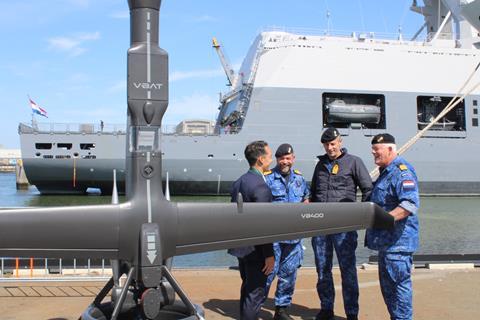
During a month-long evaluation activity conducted last year, the V-Bat was trialled aboard the service’s Rotterdam-class landing platform dock HNLMS Johan de Witt, “validating the system’s shipboard performance”.
“V-Bat was built for the types of missions the Dutch Navy and Marine Corps are preparing for – dynamic, distributed, and high-stakes,” says Shield AI president Brandon Tseng. “It’s operational today, proven in the most demanding combat environments, and delivers mission-critical capabilities unmatched by any other system,” he adds.
The procurement “reflects a decisive and focused push to field battle-proven, autonomy-enabled systems capable of operating in contested environments”, Shield AI says.
The company attributes its selection by the Netherlands as having been “informed in part by V-Bat’s demonstrated success in Ukraine, where the platform is executing long-range, long-endurance ISR and targeting with complete independence from GNSS”.
The platform’s most recent block upgrade, announced earlier this year, features the ability to operate under such GPS- and communications-denied conditions.
“Its proven performance in regions like Ukraine, the Black Sea, and the Indo-Pacific demonstrates its ability to withstand advanced electronic warfare threats that have grounded many traditional drones,” Shield AI says.
The airframer says its VTOL design can be launched and recovered in wind speeds of up to 25kt (46km/h), and from maritime vessels moving at 10kt. With a maximum take-off weight of 73kg (160lb), the platform has an operating endurance of over 13h.