











Workers involved in Boeing’s combat aircraft business have voted to strike after rejecting a final offer from the aerospace company.
In a 3 August vote, machinists in the greater St Louis, Missouri area dealt what the International Association of Machinists and Aerospace Workers (IAM) called an “overwhelming rejection” of Boeing’s 31 July contract offer.
The vote sets the stage for a work stoppage from midnight on Monday 4 August. Union members had rejected a previous Boeing deal issued on 22 July, though this had been endorsed by IAM leadership.
“IAM District 837 members have spoken loud and clear, they deserve a contract that reflects their skill, dedication, and the critical role they play in our nation’s defence,” says IAM District 837 representative Tom Boelling.
“We stand shoulder to shoulder with these working families as they fight for fairness and respect on the job.”
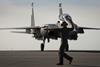
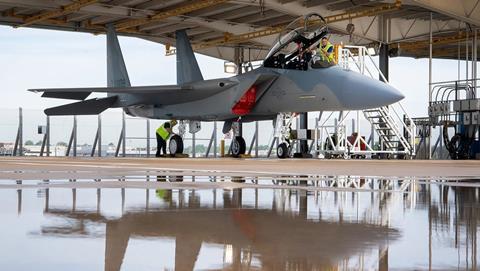
The move involves workers located at St Louis and St Charles in Missouri, as well as those located at Mascoutah, Illinois. These facilities are key to the production of types such as the F-15EX, F/A-18E/F Super Hornet, and MQ-28A Stingray unmanned refuelling aircraft.
Boeing’s revised offer, issued on 31 July, dropped a proposal for alternative workweek schedules that had been included in the earlier 22 July offer.
It accelerates pension benefits by delivering the full $10 pension multiplier increase in the first year, rather than splitting it over the second and third years. The updated offer also adds a new $0.50/h annual attendance additive for employees at the top of the pay scale.
The vote sees the union reject a $5,000 lump-sum “ratification bonus”. Boeing has said that this will be withdrawn and not offered again if workers voted to strike.
As for its overall deal, Boeing says the offer represents a 20% general wage increase, while IAM leadership has said the total package would deliver a 40% increase in total compensation for many workers.
This is the second major industrial action faced by Boeing chief executive Kelly Ortberg since he joined the company one year ago.
In 2024, the company saw a 53-day walkout by 33,000 machinists involved with Boeing’s commercial aircraft business in the Pacific northwest.
Ortberg has said that the St Louis situation is less critical than last year’s strike, which throttled the production of key commercial aircraft types.
“The order of magnitude of this is much, much less than what we saw last fall,” Ortberg said during Boeing’s second quarter earnings release on 29 July.
“I wouldn’t worry too much about the implications of the strike. We’ll manage our way through that.”