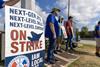














Negotiations between Boeing and striking machinists in the airframer’s fighter aircraft assembly unit remain at an impasse, with a work stoppage now entering its second month.
Boeing on 4 September told FlightGlobal that talks have not resumed with the union representing some 3,200 factory workers in the St. Louis, Missouri-area who went on strike in early August after rejecting a contract offer from the aerospace giant.
Now, Boeing says it is preparing to hire new workers to pick up the duties of its striking employees.
The company tells FlightGlobal the move is part of its pre-drafted contingency plan for a labour stoppage, with the replacement hiring triggered by failure to resolve the strike.
“Unfortunately, the union continues to demand more of everything while also saying it has no control over what it will take to end the strike, driving the parties further apart,” says Dan Gillian, Boeing’s general manager of air dominance and senior executive in St. Louis.
“As a result, we’re taking the next step in our contingency plan and hiring permanent replacement workers for manufacturing roles to ensure we’re properly staffed to keep supporting our customers,” Gillian adds.
A Boeing official tells FlightGlobal it will take some time to hire and train the new staff.

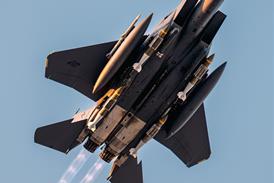
Boeing says it continues to deliver fighter aircraft from assembly lines impacted by the strike, which include the F-15EX, F/A-18E/F, MQ-25, and T-7A models.
This has been accomplished, a company official tells FlightGlobal, by re-tasking non-unionised Boeing employees in the St. Louis area who have similar skills to the striking machinists. That is also the case for the company’s precision munition production lines, which are also impacted by the strike.
Test schedules for Boeing’s developmental MQ-25 autonomous refueller and T-7A jet trainer are not expected to be substantially impacted, as those types are in early stage production with just a handful of aircraft undergoing assembly.
While some production activity has been slowed, Boeing says customers for low-volume military jets are more flexible than those awaiting aircraft from the high-volume commercial assembly lines in Washington state, which were shuttered by a protracted strike in 2024.
Machinists in that instance extracted significant wage increases from Boeing over several rounds of negotiation during the nearly two-month work stoppage. The commercial aircraft assembly workers ultimately secured a pay increase of almost 40% – compared to Boeing’s initial offer of 25%.
Workers at the fighter aircraft complex are seeking similar gains.
An offer that Boeing in July described as its “last, best and final offer” to members of the International Association of Machinists and Aerospace Workers (IAM) unit 837 included a 20% general pay rise.
Union leaders, who endorsed the deal, said at the time some members could see total compensation increases as high as 40%. IAM 837 members voted to reject the proposal by a wide margin.
“The members have the final say in what they accept or reject, and they responded loud and clear with their overwhelming vote,” IAM 837 president Tom Boelling said on 3 September. “Our members are the ones who decide their future, not the company, not politicians, not IAM Union leadership, not anyone else.”
Boeing’s move to hire replacement workers does not appear to have softened the union’s resolve.
IAM international president Brian Bryant on 4 September described the plan as Boeing ”doubling down on its mismanagement.”
”Boeing – let’s get back to the negotiating table,” Bryant says. ”Let’s get real about the concerns of our members and your employees.”
A Boeing official tells FlightGlobal the striking St. Louis-area employees are seeking additional pay increases but that the union has has not provided a specific figure.
The official says Boeing is disinclined to approve pay hikes on the scale of those approved in the Seattle area, in part due to cost of living difference between the two metro areas.
At the time of the 2024 strike, the Seattle-area workers had also gone 10 years without renegotiating their contract, while the St. Louis unit received a new labour agreement in 2022, according to Boeing.
IAM 837 president Boelling says workers also want faster wage progression and an increase to the ratification bonus provided after a labour agreement is approved.
Bryant on 4 September noted that Boeing workers in the Pacific Northwest and South Carolina received a $12,000 last year.
Boeing withdrew its initial offer of a one-time $5,000 lump-sum bonus after employees voted down the last offer in July.
The company tells FlightGlobal it does not plan to put the bonus back on the table.
Bryant describes the bonus disparity as a “slap in the face” to the St. Louis workers, while categorising the bonus withdrawal as “going backward.”
”On the strike line, I consistently heard from our members that they were offended by Boeing taking a $5,000 signing bonus off the table,” he says.
One of Missouri’s representatives in Washington has also waded into the fray. Republic Senator Josh Hawley, a longtime ally of President Donald Trump and standard-bearer of the president’s Make America Great Again movement, came out firmly in support of the striking Boeing workers in his state.
”I think what needs to happen at the end of the day is management needs to come to the table and do right by their workers,” Hawley told local news outlet Missourinet.
The firebrand senator is highly critical of Boeing management, describing the executive team as having “strip mined the company.”
“If you want anything to work, it’s got to be the good people who are on the line, the engineers and the designers, they’re the ones who Boeing needs to do right by and they haven’t,” Hawley says.
The senator also invoked the two fatal crashes of Boeing 737 Max jets in 2018 and 2019 that killed 346 people as evidence of that alleged mismanagement.
Boeing’s commercial aircraft division, which assembles the 737 Max family, is separate from the company’s defence unit, which operates the fighter aircraft production lines currently impacted by the strike. Both divisions have their own leadership teams and distinct workforces.
Executive leadership both at the overall Boeing Company and the Boeing Defense, Space & Security (BDS) unit has changed over multiple times since the fatal Max crashes.
Boeing’s main chief executive Kelly Ortberg assumed his post in August 2024, while BDS chief executive Steve Parker was only appointed on a permanent basis this past July, after Ortberg named him to the position temporarily in September 2024.
Story updated 5 September to include additional comments from IAM leadership and Missouri Senator Josh Hawley